
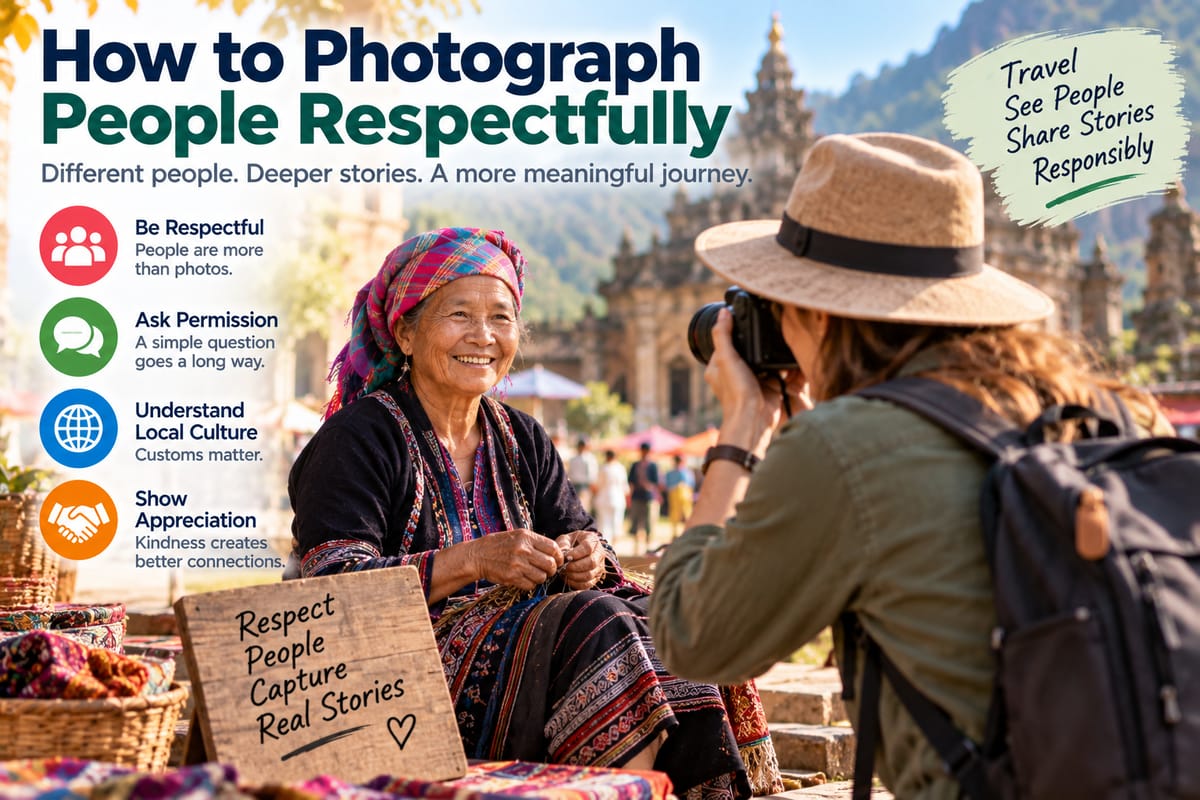
How to Photograph People Respectfully
Photographs of people can be some of the most memorable images from a trip. A market vendor preparing food, a musician performing in a public square, a family enjoying a festival, or a local craftsman working in a workshop can help tell the story of a destination in a way that buildings and landscapes sometimes cannot.
But photographing people also requires awareness and respect. A traveler may see an interesting photographic opportunity while the person being photographed sees a private moment, a cultural tradition, or simply an ordinary part of daily life.
Learning how to photograph people respectfully means balancing creativity with consent, cultural awareness, personal boundaries, and good judgment.
Why Photographing People Requires Care
A photograph can capture much more than someone’s appearance. It can record a person’s activities, surroundings, emotions, possessions, and interactions with others.
Once an image has been taken, the photographer may control how it is stored, shared, edited, or published. The person in the photograph may have little or no control over what happens afterward.
This creates an important responsibility for travelers.
Respectful photography does not mean avoiding photographs of people altogether. Instead, it means considering whether the photograph is appropriate, whether the person is comfortable, and whether the situation calls for permission.
Ask Before Taking a Close-Up Portrait
When a photograph focuses clearly on an identifiable person, asking permission is often the simplest and most respectful approach.
A traveler can make eye contact, smile, gesture toward the camera, and ask politely if the person is comfortable being photographed.
If the answer is yes, the photographer can take the picture. If the person says no, turns away, or appears uncomfortable, the appropriate response is to respect that decision.
Asking can also create a more meaningful interaction. A short conversation may provide context about the person, their work, or the place where the photograph was taken.
Not Every Situation Requires the Same Approach
Photography etiquette depends partly on the situation.
A person posing specifically for a portrait is different from someone accidentally appearing in the background of a wide landscape photograph.
Similarly, a public performance is different from a private family gathering.
Travelers should consider:
- How prominent the person is in the image
- Whether the situation appears public or private
- Whether the person is aware of the camera
- Whether the photograph could embarrass or expose them
- Whether cultural customs affect photography
- How the image will be used afterward
Good judgment is often more important than following a rigid set of rules.
Public Places Do Not Automatically Mean Everything Is Appropriate
A person standing in a public place may be visible to everyone around them, but that does not necessarily mean they would welcome a close-up photograph.
Travelers should distinguish between what is technically visible and what is respectful.
For example, photographing a busy street as a whole scene is different from approaching an individual and taking a close-up portrait without acknowledging them.
The more prominently a person features in the photograph, the more important it becomes to consider their comfort and expectations.
Learn Local Photography Customs
Photography etiquette can vary between cultures and destinations.
Some communities may have particular attitudes toward photographing:
- Religious ceremonies
- Sacred locations
- Children
- Traditional clothing
- Religious leaders
- Military or government facilities
- Indigenous communities
- Funerals
- Private homes
- Cultural performances
Travelers should research or ask about local customs when there is uncertainty.
This is particularly important when visiting places where cultural practices differ significantly from those the traveler is accustomed to.
A broader approach to understanding local traditions can be found in the Cultural Travel: Complete Guide to Meaningful Experiences.
Be Especially Careful With Children
Photographing children requires additional sensitivity.
Parents, guardians, schools, and communities may have different expectations about photographing minors. A traveler should not assume that because children are playing in a public area, they automatically welcome being photographed.
When a photograph clearly focuses on a child, seeking permission from a parent or appropriate guardian is a sensible approach.
Travelers should also be cautious about publishing identifiable photographs of children online, particularly when there is no clear reason for doing so.
Respect Religious and Sacred Situations
Religious ceremonies and sacred spaces can be deeply personal.
Some locations may prohibit photography entirely, while others may permit photographs only in certain areas or at specific times.
Before taking photographs, travelers should look for posted rules and observe how local people behave.
When in doubt, asking a guide, staff member, religious representative, or another appropriate person can help clarify what is acceptable.
A photograph should never take priority over someone’s religious practice or a sacred ceremony.
Avoid Interrupting People’s Work
Local workers can provide fascinating photographic subjects, particularly in markets, workshops, farms, restaurants, and craft businesses.
However, they are still working.
A photographer should avoid blocking customers, interrupting important tasks, or repeatedly demanding that someone pose.
If a person agrees to be photographed, it can help to take the picture efficiently and allow them to return to their work.
In some cases, purchasing a product or paying an agreed photography fee may also be appropriate, particularly when someone is deliberately posing or participating in a photography experience.
Don’t Treat People as Tourist Attractions
A common mistake in travel photography is reducing people to visual symbols of a destination.
A person should not be photographed simply because they appear “exotic,” unusual, poor, or different from the photographer’s everyday experience.
People have lives and identities that extend far beyond what appears interesting to a visitor.
Instead of treating someone as an object in the landscape, travelers can approach photography as a way of documenting genuine human experiences while maintaining respect for the individual.
Build a Connection Before Taking the Picture
Sometimes the best portraits happen after a short conversation.
Talking to someone before reaching for the camera can make the interaction feel more natural and less intrusive.
A conversation might begin with:
- Asking about their work
- Complimenting something they have created
- Asking about a local dish
- Showing genuine interest in the surrounding activity
- Learning about a cultural tradition
If the person becomes comfortable with the interaction, the photograph may also feel more authentic.
The objective should not be to manufacture an emotion but to create enough trust for the person to feel comfortable.
Be Honest About How You Will Use the Photograph
There is a meaningful difference between taking a photograph as a personal travel memory and publishing an image publicly.
If a photograph will be used for a blog, publication, commercial project, advertising campaign, or social media account, the photographer should be transparent when appropriate.
A person who agrees to a casual travel photograph may not necessarily expect their image to appear in promotional material or reach a large online audience.
When the intended use is more significant, explicit permission and appropriate releases may be necessary depending on the circumstances and applicable laws.
Respect a Refusal
One of the most important rules of respectful photography is accepting “no.”
A person may refuse because:
- They do not like being photographed
- They are busy
- They are uncomfortable with cameras
- Their cultural beliefs discourage photography
- They are having a private moment
- They simply do not want their picture taken
There is no need to argue or repeatedly ask.
A respectful photographer moves on and looks for another opportunity.
Avoid Photographing People in Vulnerable Moments
Some moments should generally be approached with particular caution.
These can include:
- Medical emergencies
- Accidents
- Funerals
- Arguments
- Visible distress
- Homelessness
- Children in vulnerable situations
- Private family conflicts
- People who are intoxicated or otherwise unable to give meaningful permission
Even when such scenes appear newsworthy or visually compelling, photographers should consider whether taking or publishing the image could cause unnecessary harm.
An emotionally powerful photograph is not automatically an ethically appropriate photograph.
Be Careful With Street Photography
Street photography often involves spontaneous moments rather than planned portraits.
Wide scenes can sometimes be photographed without interrupting the activity, but photographers should remain aware of individuals who become prominent subjects.
A useful approach is to distinguish between documenting a scene and deliberately targeting an individual.
If someone notices the camera and appears uncomfortable, the photographer can lower the camera, explain what they are doing, or simply move on.
Use Context to Tell Better Stories
Respectful photography can actually produce stronger travel stories.
Instead of photographing someone in isolation, consider including elements that explain what they are doing and where they are.
For example, a portrait of a baker becomes more meaningful when the image also shows the bakery, tools, ingredients, or preparation process.
A photograph of a craftsperson can tell more of a story when it captures the workshop and the object being made.
Travel photography becomes more informative when people are shown as participants in their environment rather than simply as subjects.
For additional guidance on creating stronger visual narratives, see How to Take Better Travel Photos and Tell Visual Stories.
Consider Offering a Copy of the Photograph
If someone has willingly posed for a portrait, offering to show them the photograph can be a thoughtful gesture.
With a smartphone or digital camera, the photographer may be able to show the image immediately.
If appropriate, the traveler can offer to share the photograph later.
This turns the interaction into something more reciprocal rather than making the photographer the only person who benefits from the encounter.
Be Mindful When Photographing Markets
Markets are popular destinations for travel photographers because they are full of color, activity, food, crafts, and human interaction.
However, vendors are there to work and earn a living.
Travelers should avoid blocking stalls, touching merchandise without permission, or repeatedly photographing someone without acknowledging them.
If a vendor is selling products, purchasing something can also create a more natural opportunity for conversation and photography.
Photographing Festivals and Public Events
Festivals can provide excellent opportunities to document music, clothing, food, dance, and community traditions.
Because these events are often public, photography may be expected to some degree. However, public participation does not eliminate the need for cultural awareness.
Travelers should pay attention to event rules and avoid disrupting performers or participants.
If a ceremony has a clearly private or sacred component, the photographer should follow local instructions even if cameras are otherwise common at the event.
Don’t Use Photography to Stereotype a Destination
A collection of travel photographs can influence how viewers perceive an entire country or community.
If every photograph emphasizes poverty, unusual customs, crowded streets, or other highly selective subjects, the resulting story may create an incomplete impression of the destination.
A stronger travel collection can show a range of experiences:
- Everyday life
- Architecture
- Food
- Nature
- Work
- Family activities
- Recreation
- Cultural events
- Local businesses
- Quiet moments
This creates a fuller representation of the places people visit.
Photography Should Add to the Travel Experience
Travelers sometimes become so focused on getting the perfect photograph that they stop experiencing the moment itself.
A camera should support the travel experience rather than completely replace it.
Put the camera away when appropriate. Listen to conversations. Observe what is happening around you. Participate in activities rather than constantly viewing them through a screen.
The most meaningful photographs often come from travelers who take time to understand what they are seeing.
This broader approach fits naturally into an International Travel Guide, where preparation, cultural awareness, and responsible behavior are important parts of traveling across borders.
Respect Privacy When Sharing Photographs Online
Taking a photograph respectfully is only the first step.
Travelers should also think about what happens when an image is uploaded to social media or another public platform.
Before posting, consider:
- Is the person identifiable?
- Did they understand that the photograph might be shared?
- Does the image reveal sensitive information?
- Are children visible?
- Does the caption accurately describe the situation?
- Could the photograph embarrass or harm someone?
Adding a location tag can also reveal where a person lives or works, which may create privacy concerns in some situations.
Be Careful With Captions
A photograph can be misunderstood when it is presented without context.
Captions should avoid making unsupported assumptions about someone’s identity, income, beliefs, occupation, or circumstances.
For example, a photographer should not label someone as “poor,” “traditional,” “homeless,” or another potentially sensitive description simply because of their appearance or surroundings.
When the photographer does not know something about a person, it is better not to invent a story.
Photography and Responsible Travel
Responsible travel involves recognizing that destinations are communities rather than backdrops.
People who live in tourist destinations should not have to sacrifice their privacy or dignity simply because visitors find their surroundings interesting.
Photography can support cultural understanding when it is approached with curiosity and respect.
It can also become intrusive when travelers prioritize obtaining an image over the comfort of the person in front of the camera.
The difference often comes down to awareness, communication, and judgment.
Let Respect Guide the Photograph
Good travel photography is not only about composition, lighting, timing, or camera equipment. It is also about understanding the people and places being photographed.
Before taking a picture, consider whether the person is comfortable, whether the situation is appropriate, and whether the image tells a genuine story rather than reinforcing a stereotype.
When permission is appropriate, ask. When someone declines, respect the decision. When cultural rules apply, follow them. And when a moment is clearly private or vulnerable, sometimes the most respectful photograph is the one you choose not to take.
Travel activities can provide countless opportunities for meaningful photographs, particularly when travelers engage thoughtfully with the places they visit. How Travel Activities Shape Destination Experiences offers a broader perspective on how those experiences can become part of a richer travel story.


2 Comments
Micle harison
June 7, 2019Lorem ipsum dolor sit amet, usu ut perfecto postulant deterruisset, libris causae volutpat at est, ius id modus laoreet urbanitas. Mel ei delenit dolores.
John Doe
June 7, 2019Some consultants are employed indirectly by the client via a consultancy staffing company.