
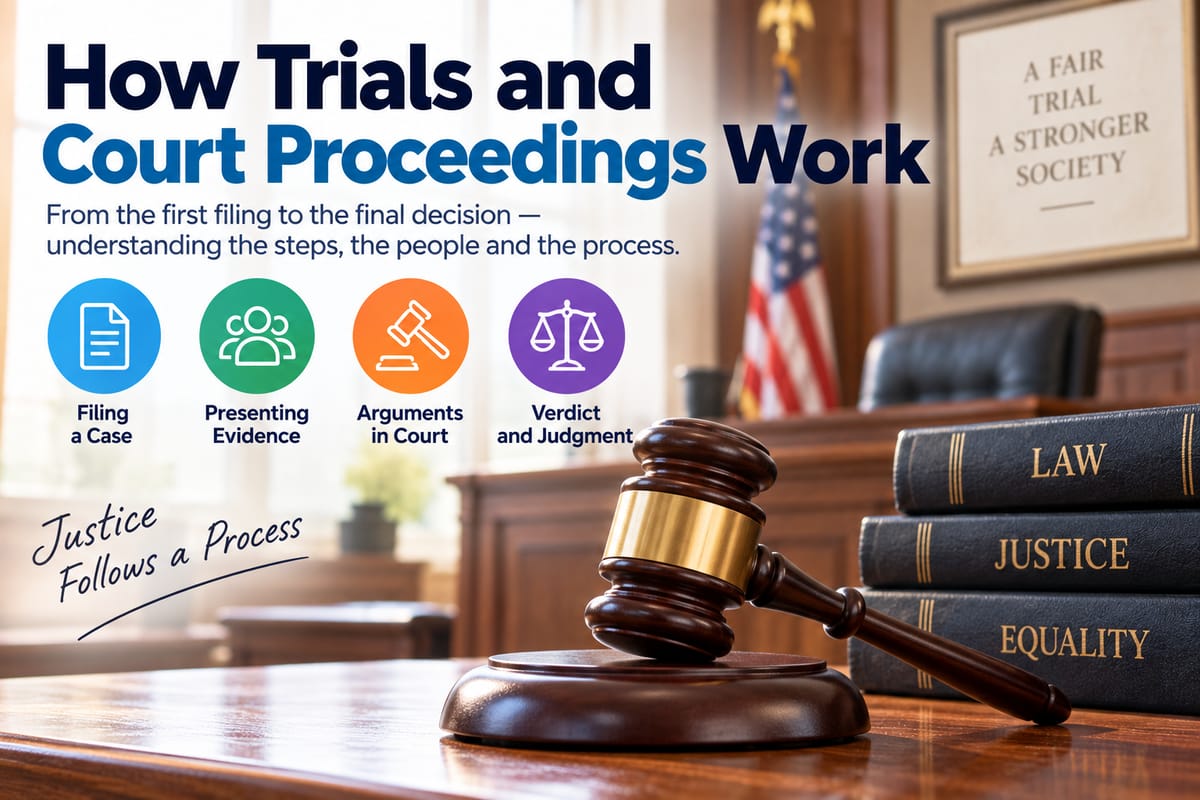
How Trials and Court Proceedings Work
Trials are among the most recognizable parts of the legal system, but a courtroom trial is usually only one stage of a much longer process.
Before a case reaches trial, courts and the parties may deal with filings, preliminary hearings, evidence, motions, negotiations, and other procedural matters. After the trial, there may be a judgment, sentencing, post-trial motions, or an appeal.
The exact procedure differs between countries and between criminal, civil, constitutional, and administrative cases. Even within one country, different courts can follow different rules.
At its core, however, a court proceeding is a structured process for resolving a legal dispute or determining whether a legal violation has been established. Judges apply the relevant law, parties present arguments and evidence, and juries may determine disputed facts where the legal system provides for jury trials.
What Is a Court Proceeding?
A court proceeding is a formal process in which a court considers a legal matter.
Court proceedings can involve many different activities, including:
- Filing legal documents
- Preliminary hearings
- Evidence gathering
- Witness testimony
- Legal arguments
- Motions
- Trials
- Sentencing
- Judgments
- Appeals
Not every case goes through every stage.
For example, a civil dispute may be resolved through settlement before a trial begins. A criminal defendant may enter a guilty plea rather than proceed to a full trial. Some cases may be dismissed because of procedural or legal problems.
The U.S. federal court system, for example, describes criminal cases as involving stages such as investigation, charging, arraignment, discovery, pretrial motions, trial, sentencing, and appeal.
What Is a Trial?
A trial is a formal court proceeding in which the parties present evidence and legal arguments so that the court or jury can resolve disputed issues.
In a criminal trial, the prosecution presents evidence intended to establish that the accused committed the charged offense. The defense has an opportunity to challenge that evidence and present its own case.
In a civil trial, parties present evidence concerning a dispute between them. One party may seek compensation, a court order, or another form of legal relief.
The judge oversees the proceeding and determines legal questions. Depending on the legal system and type of case, a jury may determine certain factual questions.
U.S. federal district courts, for example, are trial courts that conduct trials and hearings and resolve disputes by determining facts and applying law to those facts.
Criminal Cases and Civil Cases
One of the most important distinctions in court proceedings is between criminal and civil cases.
Criminal Cases
Criminal cases generally involve allegations that a person or organization violated criminal law.
The government brings the prosecution, and the accused person is the defendant.
Potential consequences can include imprisonment, fines, probation, or other penalties, depending on the jurisdiction and offense.
In the U.S. federal system, the government carries the burden of proving guilt beyond a reasonable doubt. The defendant does not have to prove innocence.
Civil Cases
Civil cases generally involve disputes over rights, responsibilities, injuries, contracts, property, money, or other legal interests.
A person, organization, or government entity may bring a civil claim against another party.
Depending on the case, a court may award monetary damages, issue an order requiring or prohibiting particular conduct, or provide another form of legal relief.
In U.S. federal civil cases, the plaintiff generally must establish the claim by a preponderance of the evidence, meaning the claim is more likely than not to be true.
The terminology and standards can differ substantially between jurisdictions.
How a Case Begins
The beginning of a court case depends on its type.
A civil case commonly begins when a claimant or plaintiff files a formal complaint or similar document with a court.
The document generally explains the dispute, identifies the legal basis for the claim, describes the alleged harm, and states what remedy is being requested.
The opposing party must then receive appropriate notice through a process known as service.
In the U.S. federal system, a civil action begins when the plaintiff files a complaint and serves it on the defendant.
Criminal cases begin differently.
A criminal investigation may precede formal charges. Prosecutors then determine whether charges should be brought under the applicable legal system.
Jurisdiction Determines Which Court Can Hear a Case
Before a court can decide a dispute, it generally must have legal authority to hear it.
This authority is known as jurisdiction.
Jurisdiction can involve questions such as:
- What type of dispute is involved?
- Where did the relevant events occur?
- Who are the parties?
- What laws apply?
- Does the court have authority over the subject matter?
- Does the court have authority over the people or entities involved?
Jurisdiction is important because a court cannot simply decide every legal dispute that someone brings before it.
The rules governing jurisdiction vary significantly between countries and court systems.
The Role of Judges
Judges have an important role throughout court proceedings.
Depending on the type of case, a judge may:
- Interpret and apply the law
- Decide procedural questions
- Rule on motions
- Determine whether evidence can be admitted
- Manage courtroom proceedings
- Give instructions to a jury
- Decide cases heard without a jury
- Impose sentences in criminal cases
- Issue judgments or orders
Judges are therefore responsible for maintaining the legal and procedural framework within which a case is heard.
The broader relationship between courts and legal rules is explored in How Courts Interpret and Apply Laws.
The Role of Lawyers
Lawyers represent parties in many types of court proceedings.
A lawyer may:
- Prepare legal documents
- Investigate facts
- Interview witnesses
- Analyze evidence
- Research legal authorities
- File motions
- Question witnesses
- Make legal arguments
- Negotiate settlements
- Represent a client during hearings and trial
In criminal cases, the prosecution represents the government, while the defense represents the accused.
In civil cases, lawyers may represent the plaintiff, defendant, or other parties with an interest in the dispute.
What Is Discovery?
Discovery is the process through which parties obtain and exchange relevant information before trial.
The exact rules differ between jurisdictions and types of cases.
Discovery may involve:
- Documents
- Written questions
- Requests for information
- Witness information
- Expert evidence
- Depositions
- Other forms of evidence
The purpose is generally to allow parties to understand the evidence and arguments that may become relevant to the case.
In U.S. federal civil litigation, discovery can include exchanging documents and taking depositions in which witnesses answer questions under oath.
Criminal cases can have different discovery rules, particularly because the government and defense have different legal responsibilities.
What Are Motions?
A motion is a formal request asking a court to make a particular ruling.
Motions can arise before, during, or after a trial.
For example, a party might ask the court to:
- Dismiss a case
- Exclude certain evidence
- Compel another party to provide information
- Change a procedural deadline
- Resolve a legal issue
- Enter judgment without a full trial
The opposing party normally has an opportunity to respond, and the judge then decides whether to grant or deny the request.
Motions can significantly affect what issues ultimately reach trial.
Can a Case End Before Trial?
Yes.
A case does not necessarily need to reach a courtroom trial.
Civil cases may be resolved through:
- Settlement
- Mediation
- Arbitration
- Dismissal
- A court ruling before trial
- Other negotiated or procedural resolutions
In U.S. federal civil litigation, courts encourage alternative dispute resolution, and many civil cases end through settlement or judicial action before trial.
Criminal cases can also end without a trial.
A defendant may plead guilty, or prosecutors may dismiss charges under circumstances permitted by law.
What Happens Before a Criminal Trial?
A criminal case can involve several stages before the actual trial.
These can include:
- Investigation
- Charging
- Initial appearance
- Arraignment
- Discovery
- Plea negotiations
- Preliminary proceedings
- Pretrial motions
The precise sequence varies by jurisdiction.
In the U.S. federal system, defendants who plead not guilty proceed toward trial, while defendants who plead guilty generally move toward sentencing.
What Is an Arraignment?
An arraignment is a court proceeding in which criminal charges are formally presented to the accused and the defendant enters a plea.
Common pleas include:
- Guilty
- Not guilty
- In some jurisdictions, other legally recognized pleas
The precise procedure varies.
An arraignment can also involve decisions concerning legal representation, detention, release conditions, and future court dates.
What Is Bail or Pretrial Release?
Some legal systems allow defendants to remain in the community while awaiting trial, subject to conditions.
Depending on the jurisdiction and case, conditions may include:
- Appearing at scheduled hearings
- Restrictions on travel
- Reporting requirements
- Contact restrictions
- Electronic monitoring
- Financial conditions
The purpose and operation of pretrial release vary substantially among jurisdictions.
The question of whether someone should remain detained before trial is separate from the question of whether the person is ultimately guilty.
How Jury Selection Works
When a jury trial is available and requested, potential jurors are selected from an eligible pool.
The parties and judge may question potential jurors in a process commonly known as voir dire.
The purpose is to identify whether prospective jurors can fairly perform their role and whether any legal grounds exist for excluding particular individuals.
The number of jurors and exact selection procedures vary by jurisdiction and case.
In U.S. federal criminal trials, jury selection is governed by procedures designed to produce an impartial jury, with the Sixth Amendment providing a constitutional right to a jury trial in criminal cases.
What Happens During Opening Statements?
Opening statements generally occur near the beginning of a trial.
Each side explains what it expects the evidence to show.
An opening statement is not normally the time to prove the case through argument alone. Instead, it gives the judge or jury a framework for understanding the evidence that will follow.
The order of opening statements depends on the type of case and applicable court rules.
How Evidence Is Presented
Evidence is central to a trial.
It can include:
- Documents
- Photographs
- Physical objects
- Digital records
- Expert testimony
- Witness testimony
- Audio or video
- Other admissible material
Not everything that exists can necessarily be presented to a court.
Rules of evidence determine whether particular information can be admitted.
Judges can rule on objections concerning relevance, reliability, prejudice, authentication, hearsay, and other evidentiary issues.
The U.S. federal judiciary notes that the Federal Rules of Evidence provide a framework governing the admission and exclusion of evidence during trials.
How Witness Testimony Works
Witnesses may provide information based on what they personally observed, heard, experienced, or otherwise know within the rules governing testimony.
A lawyer generally questions a witness through direct examination.
The opposing lawyer may then conduct cross-examination.
Depending on the circumstances, further questioning may follow.
Cross-examination gives the opposing side an opportunity to challenge testimony, explore inconsistencies, test credibility, or develop other relevant information.
What Is an Objection?
An objection occurs when a lawyer argues that a question, answer, piece of evidence, or procedure does not comply with the applicable rules.
The judge decides whether the objection should be sustained or overruled.
If an objection is sustained, the challenged question or evidence may be excluded or the lawyer may be required to change the question.
If an objection is overruled, the evidence or question may generally proceed, subject to the court’s ruling.
The process helps ensure that trials operate according to established evidentiary and procedural rules.
What Happens After the Evidence Is Presented?
Once the parties have presented their evidence, they generally make closing arguments.
Closing arguments allow lawyers to explain how they believe the evidence should be interpreted and how the applicable law should apply.
The parties do not normally introduce entirely new evidence during closing arguments.
Instead, they use the evidence already admitted during the proceeding to make their final case.
What Does the Judge Do Before a Jury Deliberates?
In a jury trial, the judge explains the legal principles and questions the jury must apply.
These instructions are important because jurors determine facts while applying the law explained by the judge.
The exact wording and procedure differ between jurisdictions.
In U.S. federal criminal trials, the judge gives jury instructions after closing arguments and before deliberations.
What Are Jury Deliberations?
Jury deliberations are the process through which jurors privately discuss the evidence and attempt to reach the required decision.
Jurors generally consider the facts presented during the trial and apply the legal instructions provided by the judge.
They do not normally conduct a separate investigation into the case.
In U.S. federal trials, jury deliberations are private.
What Is a Verdict?
A verdict is the formal decision reached at the end of a jury trial.
In a criminal case, a verdict may determine whether the defendant is guilty or not guilty of the charged offense.
In a civil case, a verdict may determine whether the plaintiff or defendant prevails on the issues submitted to the jury.
Where a case is decided by a judge rather than a jury, the judge makes the relevant factual and legal determinations according to the applicable procedure.
What Happens After a Guilty Verdict?
In a criminal case, a guilty verdict generally leads to a sentencing process.
The judge determines the sentence according to applicable law and sentencing rules.
Possible consequences vary widely and can include imprisonment, fines, probation, restitution, community-based penalties, or other legally authorized sanctions.
A guilty verdict and sentencing are therefore separate stages.
The verdict establishes the outcome on the criminal charge, while sentencing determines the legal consequences.
What Happens After a Civil Verdict?
In a civil case, the court determines the remedy that follows from the judgment.
Depending on the case, the remedy may involve:
- Monetary damages
- An injunction
- A declaration of legal rights
- An order requiring a party to take or stop a particular action
- Another form of relief authorized by law
The remedy depends on the nature of the dispute and the applicable legal rules.
What Is a Judgment?
A judgment is the formal resolution entered by a court.
It records the court’s decision and can establish the legal obligations or rights resulting from the case.
A judgment is different from the arguments made by lawyers or the evidence presented by witnesses.
It represents the court’s formal disposition of the issues before it.
Can a Court Decision Be Challenged?
Many legal systems provide mechanisms for challenging certain court decisions.
A party may be able to file:
- A post-trial motion
- A motion for reconsideration
- An appeal
- Another legally authorized review
An appeal is generally not a completely new trial.
An appellate court typically reviews whether the lower court made a legal or procedural error under the applicable standards of review.
How Appeals Work
An appeal allows a higher court to review certain aspects of a lower court’s decision.
The parties generally submit written arguments explaining why the lower court’s decision should be affirmed, reversed, or otherwise modified.
An appellate court may review issues involving:
- Interpretation of law
- Procedural errors
- Evidentiary rulings
- Constitutional questions
- Instructions given to a jury
- Other legal issues
The scope of review depends on the type of issue and applicable law.
In the U.S. federal system, district courts are trial courts, circuit courts provide the first level of federal appellate review, and the Supreme Court is the highest court in the federal system.
How Courts Interpret the Law During Proceedings
Trials are not simply exercises in presenting facts.
Courts must also determine which legal rules apply and how those rules should be interpreted.
A judge may need to interpret statutes, regulations, constitutional provisions, previous judicial decisions, procedural rules, or other legal authorities.
This is why understanding How Courts Interpret and Apply Laws is important when examining what happens inside a courtroom.
The interpretation of law can affect what evidence is admissible, what arguments are legally relevant, what instructions a jury receives, and what remedy a court can provide.
The Rule of Law and Court Proceedings
Court proceedings operate within a broader principle known as the rule of law.
The concept generally emphasizes that government authority and legal disputes should be governed by established laws and legal procedures rather than arbitrary decisions.
Courts are one part of the institutional framework through which laws are interpreted and applied.
For a broader explanation of this principle, What the Rule of Law Means and How Legal Governance Works examines how legal rules structure government and public authority.
How Constitutions Affect Court Proceedings
Constitutions can establish fundamental rules governing courts and the relationship between different branches of government.
Depending on the country, a constitution may address:
- Judicial independence
- Fundamental rights
- Due process
- Separation of powers
- Court structures
- Jurisdiction
- Limits on government authority
- Rights of accused persons
These constitutional principles can affect both the way courts operate and the rights of people involved in legal proceedings.
The broader relationship between constitutions and government institutions is explored in The Complete Guide to Constitutions.
Courts Within Political Systems
Courts do not operate separately from the wider political and institutional structure of a country.
Political systems determine how judicial institutions are established, how judges are selected or appointed, what powers courts possess, and how courts interact with legislatures and executives.
At the same time, judicial institutions can exercise legal powers that affect government action.
These relationships vary substantially across political systems. A broader overview is available in The Complete Guide to Political Systems.
Why Court Proceedings Follow Formal Rules
Court procedures may appear complicated, but formal rules serve several purposes.
They help establish:
- Notice to the parties
- Opportunities to respond
- Standards for presenting evidence
- Procedures for questioning witnesses
- Time limits
- Methods for challenging decisions
- Records of proceedings
- Standards for judicial decision-making
Without procedural rules, parties could face uncertainty about how disputes would be presented and resolved.
The rules also help courts manage large numbers of cases in an organized way.
Why Not Every Case Goes to Trial
A common misconception is that filing a case automatically leads to a courtroom trial.
In reality, many cases end earlier.
Civil disputes may settle, be dismissed, or be resolved through a pretrial ruling. Criminal defendants may plead guilty rather than proceed to trial.
In the U.S. federal system, official court materials note that the overwhelming majority of civil cases are resolved before trial through settlement or judicial action.
This means the trial is often only one possible stage within a larger legal process.
Why Court Proceedings Can Take Time
Legal proceedings can take months or even years depending on the complexity of the dispute and the court system involved.
Potential causes of delay include:
- Large amounts of evidence
- Many witnesses
- Complex legal questions
- Multiple parties
- Expert testimony
- Discovery disputes
- Pretrial motions
- Scheduling difficulties
- Appeals
- Settlement negotiations
Courts must balance the need to move cases forward with the need to provide parties with meaningful opportunities to present their cases.
The Importance of a Court Record
Court proceedings generally generate formal records.
These can include:
- Filings
- Orders
- Transcripts
- Exhibits
- Motions
- Evidence
- Judgments
- Appellate decisions
The record allows parties and reviewing courts to understand what happened during the case.
It can also support transparency and accountability, although some information may be sealed or restricted under applicable laws.
Trials Are Only One Part of the Judicial Process
A courtroom trial may be the most visible part of a legal dispute, but it sits within a much larger framework.
A case can begin with an investigation or legal complaint, move through preliminary proceedings and evidence gathering, reach a trial, and then continue through judgment, sentencing, post-trial proceedings, or appeal.
The details vary according to the country, court, and type of case, but the underlying purpose is consistent: to provide a structured legal process through which disputes and allegations can be considered according to established rules.
Understanding how filings, evidence, witnesses, judges, juries, motions, verdicts, judgments, and appeals fit together makes court proceedings easier to understand and provides a clearer view of how judicial institutions function within a legal and political system.




2 Comments
Micle harison
June 7, 2019Lorem ipsum dolor sit amet, usu ut perfecto postulant deterruisset, libris causae volutpat at est, ius id modus laoreet urbanitas. Mel ei delenit dolores.
John Doe
June 7, 2019Some consultants are employed indirectly by the client via a consultancy staffing company.