
What Is Dark Energy and What Does It Do?
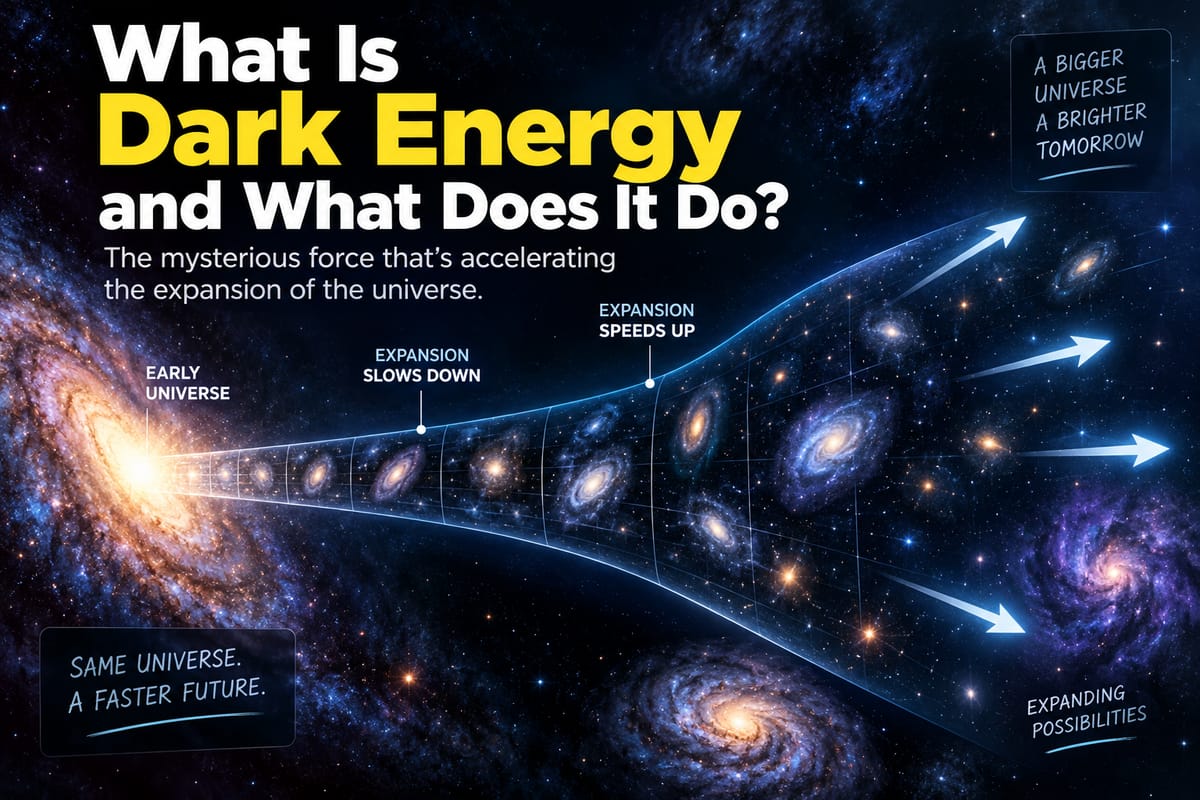
The universe is expanding. Galaxies that are far away from one another are generally becoming more separated over time, and observations show that this expansion has been speeding up during relatively recent cosmic history.
Scientists use the term dark energy to describe whatever is responsible for this accelerating expansion.
Despite its name, dark energy is not simply another kind of ordinary matter, and scientists do not yet know exactly what it is. It is one of the biggest unresolved questions in modern cosmology.
Dark energy appears to make up a large portion of the universe’s overall energy budget, yet it cannot currently be directly observed in the way stars, planets, and galaxies can. Scientists instead infer its existence from the way the universe expands and evolves.
Understanding dark energy requires looking at some of the biggest questions in astronomy, including how the universe began, how its expansion has changed, and what its future might look like.
A broader introduction to these questions can be found in The Complete Guide to Astronomy.
What Is Dark Energy?
Dark energy is the name scientists give to the unknown component associated with the accelerating expansion of the universe.
The term does not describe a substance that has been directly collected or photographed.
Instead, it represents an explanation for observations showing that cosmic expansion is not simply continuing at a constant rate or gradually slowing because of gravity.
Scientists know that gravity acts across the universe and tends to pull matter together. For much of cosmic history, gravity influenced how matter gathered into galaxies, galaxy clusters, and larger structures.
But observations indicate that the expansion of the universe has entered a period of acceleration.
Something appears to be associated with that behavior.
That unknown component is called dark energy.
Why Is It Called “Dark” Energy?
The word dark does not mean that dark energy is literally black or invisible in the ordinary sense.
In astronomy, “dark” is often used for something whose nature is unknown or whose presence is inferred indirectly.
Dark matter is another example, although dark matter and dark energy are very different concepts.
Dark matter appears to contribute additional gravitational effects that influence the motion and structure of galaxies and larger cosmic systems.
Dark energy, by contrast, is associated with the large-scale expansion of the universe.
The distinction is explored in greater detail in What Dark Matter Is and Why It Matters.
Is Dark Energy a Form of Matter?
There is currently no evidence that dark energy is ordinary matter.
Matter forms stars, planets, gas clouds, dust, and other structures. It has gravitational effects and participates in the formation of cosmic structures.
Dark energy behaves differently in cosmological models.
The simplest explanation treats dark energy as a property associated with space itself. Under this interpretation, empty space has an energy density that remains approximately constant as the universe expands.
This idea is commonly represented by the cosmological constant, often written as the Greek letter Λ, in the standard cosmological model.
However, the cosmological constant is not the only possibility scientists consider.
How Do We Know Dark Energy Exists?
Scientists do not observe dark energy directly.
Instead, they observe the behavior of the universe and compare those observations with predictions from different cosmological models.
Several types of evidence have contributed to the modern picture of cosmic acceleration.
These include observations involving:
- Distant supernovae
- The cosmic microwave background
- The large-scale distribution of galaxies
- Baryon acoustic oscillations
- The growth of cosmic structure
- Gravitational lensing
- Measurements of the universe’s expansion history
When these observations are considered together, they provide strong evidence that the universe’s expansion history cannot be explained by ordinary matter alone.
The Discovery of Cosmic Acceleration
One of the most important developments in modern cosmology came from observations of distant Type Ia supernovae.
These stellar explosions can be useful as distance indicators because their intrinsic brightness can be estimated under appropriate circumstances.
By comparing how bright these supernovae appear with how their light has been redshifted, astronomers can investigate how the universe has expanded over time.
In the late 1990s, independent research teams reported evidence that cosmic expansion had been accelerating.
The result was surprising because gravity from matter was expected to contribute to a slowing of expansion.
The discovery changed scientists’ understanding of the universe and led to the widespread use of dark energy as the name for whatever causes or represents the observed acceleration.
What Does Accelerating Expansion Mean?
It is important to understand what scientists mean when they say that the universe is expanding faster.
The idea is not simply that individual galaxies are flying through space at increasingly high speeds.
On very large scales, the distances between gravitationally unbound regions of the universe increase as space itself expands.
A useful analogy is the surface of an inflating balloon. If dots are placed on the surface, the dots become farther apart as the balloon expands.
The analogy has limitations because the universe is not literally the surface of a balloon, but it helps illustrate the difference between objects moving through space and the expansion of space itself.
Does Dark Energy Push Galaxies Apart?
It is common to describe dark energy as a force that “pushes” galaxies apart.
That description can be useful as a simplified explanation, but it can also be misleading.
Dark energy is not known to be a conventional force that acts like a rocket engine or a repulsive field pushing individual galaxies.
Instead, in the simplest cosmological model, dark energy affects the relationship between the expansion of space and the energy content of the universe.
Its effects become especially important over enormous distances and cosmic timescales.
Within galaxies, solar systems, and other gravitationally bound structures, local forces are much more important than the expansion of the universe.
Dark Energy Does Not Tear Apart Everything
The accelerated expansion of the universe does not mean that every structure is expanding internally.
The Milky Way does not expand because of dark energy in the same way that the distances between extremely distant galaxies increase.
The gravitational forces holding a galaxy together are much stronger than the extremely weak effects associated with cosmic expansion at that scale.
The same principle applies to the solar system.
The planets remain gravitationally bound to the Sun, while the Moon remains gravitationally bound to Earth.
Dark energy becomes most significant when considering the universe on its largest scales.
How Much of the Universe Is Dark Energy?
The standard cosmological picture indicates that dark energy accounts for roughly 70% of the universe’s total energy budget, with the exact estimated proportion depending on the cosmological parameters and datasets being used.
The remainder is dominated by matter, including both ordinary matter and dark matter, along with a much smaller contribution from other components such as radiation.
These proportions are not simply a count of visible objects.
They represent the contributions of different components to the overall dynamics of the universe.
This is one reason the universe can contain relatively little ordinary matter while still having an enormous amount of energy associated with dark energy in cosmological models.
Dark Energy and Dark Matter Are Not the Same
The similar names can cause confusion, but dark matter and dark energy play very different roles.
Dark matter:
- Contributes gravitational effects
- Helps galaxies and larger structures form and remain organized
- Does not appear to interact strongly with light
- Behaves approximately like matter on large scales
Dark energy:
- Is associated with accelerated cosmic expansion
- Becomes increasingly important in the universe’s large-scale dynamics
- Is not understood as a conventional form of matter
- May represent a property of space itself
Both are called “dark” because their fundamental nature remains uncertain, but they should not be treated as two versions of the same phenomenon.
What Is the Cosmological Constant?
The cosmological constant is one of the leading ways of describing dark energy.
The concept dates back to Albert Einstein, who introduced a cosmological constant into his equations of general relativity.
The historical context is complicated, but the modern interpretation is particularly interesting.
If the cosmological constant represents a constant energy density of empty space, then as the universe expands, the amount of space increases while the energy density associated with this component remains approximately constant.
This behavior can produce accelerated expansion.
The cosmological constant is therefore a central part of the standard ΛCDM model, where Λ represents the cosmological constant and CDM represents cold dark matter.
What Is Vacuum Energy?
One possibility is that dark energy is related to the energy of empty space, sometimes called vacuum energy.
Quantum physics suggests that even what we call empty space is not necessarily completely featureless.
Quantum fields exist throughout space, and their lowest-energy states have physical properties.
The idea that vacuum energy could contribute to cosmic acceleration is theoretically attractive, but connecting quantum field calculations with the observed value of dark energy presents a major unresolved problem.
The predicted and observed scales appear dramatically different under straightforward approaches.
This discrepancy is one of the major theoretical puzzles in modern physics.
Could Dark Energy Change Over Time?
Another major question is whether dark energy is truly constant.
The simplest model assumes that dark energy has an approximately constant density and behaves like the cosmological constant.
But scientists have also considered models in which the properties of dark energy change over time.
Possible ideas include dynamic fields sometimes grouped under the term quintessence and other modifications to the standard description of gravity or cosmic expansion.
Determining whether dark energy changes over time is an important goal of modern cosmology.
If future observations show that its behavior evolves, scientists may need to reconsider the standard cosmological model.
Why the Equation of State Matters
Scientists often describe dark energy using a quantity known as its equation-of-state parameter, commonly represented by w.
In simple terms, this parameter helps describe the relationship between dark energy’s pressure and energy density.
For a cosmological constant, the expected value is:
w = -1
A measurement significantly different from this value could suggest that dark energy is not a simple cosmological constant.
Determining the value of w accurately is therefore an important observational challenge.
How Scientists Study Dark Energy
Dark energy cannot be examined by collecting a sample in a laboratory.
Instead, scientists study its influence on the universe.
Several observational approaches are especially important.
Type Ia Supernovae
Distant supernovae can help scientists reconstruct how the expansion rate has changed over cosmic time.
Galaxy Surveys
Large surveys map millions or billions of galaxies to study how matter is distributed across enormous volumes of space.
Baryon Acoustic Oscillations
Baryon acoustic oscillations provide a characteristic scale in the distribution of galaxies that can be used as a cosmic distance measurement.
Cosmic Microwave Background
The cosmic microwave background contains information about the early universe. Comparing these observations with the later universe helps scientists test cosmological models.
Weak Gravitational Lensing
The gravitational influence of matter bends light from distant galaxies. Mapping this effect can help scientists study the distribution and growth of cosmic structure.
Together, these methods provide different ways to test the expansion history of the universe.
Why the Size of the Universe Matters
Dark energy becomes especially important when scientists examine the universe on enormous scales.
The observable universe contains vast numbers of galaxies spread across immense distances. The scale involved is difficult to visualize because the observable region is far larger than the part of the universe that can be directly explored by spacecraft.
The question of cosmic scale is explored in How Large Is the Known Universe.
The larger the distances and longer the timescales considered, the more important the overall expansion history becomes.
Dark Energy and the Fate of the Universe
One of the most fascinating consequences of dark energy is its potential influence on the future of the universe.
If dark energy continues behaving approximately like a cosmological constant, cosmic expansion is expected to continue accelerating over the distant future.
As the universe expands, distant galaxies will become increasingly separated.
Over extremely long periods, many galaxies outside our local gravitationally bound region could eventually become impossible for future observers to see because their light would no longer be able to reach them.
This does not mean that the universe necessarily ends.
Instead, it would become increasingly cold, dark, and separated as expansion continues.
The broader possibilities for cosmic evolution are explored in What Could Happen to the Universe in the Future.
Could Dark Energy Eventually Tear the Universe Apart?
One theoretical possibility is known as the Big Rip.
In this scenario, dark energy would become increasingly powerful over time rather than remaining constant.
If its effects grew sufficiently strong, cosmic expansion could eventually overcome the forces holding together increasingly smaller structures.
In an extreme version of the scenario, galaxies, stars, planets, and even atoms could eventually be disrupted.
However, the Big Rip is not the standard prediction of the simplest cosmological model.
It depends on particular assumptions about the properties and evolution of dark energy.
Could Dark Energy Disappear?
Another possibility is that dark energy could change in strength or behavior over cosmic time.
If its properties evolve, the long-term expansion history of the universe could differ significantly from the constant-dark-energy scenario.
The universe could potentially experience different expansion behavior depending on the underlying physics.
This is one reason researchers continue to search for evidence that might reveal whether dark energy is truly constant.
Could Our Understanding of Gravity Be Incomplete?
Not every explanation for cosmic acceleration requires a new form of energy.
Another possibility is that our understanding of gravity might need modification on the largest scales.
General relativity has passed an enormous number of experimental and observational tests, but scientists continue to investigate whether alternative theories could explain cosmic acceleration without invoking dark energy in the conventional sense.
This makes the problem particularly interesting.
Scientists are effectively asking two broad questions:
Is there an unknown component of the universe affecting expansion?
Or:
Does our theory of gravity need to change when applied to the largest possible scales?
Current observations strongly constrain possible alternatives, but the underlying explanation remains an active area of research.
Why Dark Energy Is Difficult to Understand
Dark energy presents a unique scientific challenge because its effects are spread across enormous distances and timescales.
Scientists cannot simply isolate a piece of dark energy and study it in a laboratory.
Instead, they have to reconstruct its properties from observations of the universe itself.
That means researchers must account for:
- Measurement uncertainties
- Calibration
- Cosmic distances
- Galaxy formation
- Matter distribution
- Supernova properties
- Gravitational effects
- Statistical uncertainties
- Model assumptions
Different observational techniques can also have different systematic uncertainties.
Scientists therefore compare many independent datasets rather than relying on a single measurement.
What Scientists Still Don’t Know
Despite decades of research, several fundamental questions remain unanswered.
Scientists do not yet know with certainty:
- What dark energy physically is
- Whether it is a cosmological constant
- Whether its properties change with time
- Whether it is related to quantum vacuum energy
- Whether a new field is responsible
- Whether modified gravity can explain the observations
- Why its observed value has the magnitude it does
These are not minor details.
They concern some of the most fundamental properties of the universe.
The Importance of Better Cosmic Measurements
Future astronomical surveys and observatories are designed to measure the universe with increasing precision.
Researchers want to map galaxies, measure cosmic distances, track the growth of large-scale structures, and examine how the expansion rate has changed over billions of years.
Improved measurements could help determine whether the cosmological constant remains consistent with observations or whether subtle deviations are emerging.
If scientists discover that dark energy changes with time, it could provide evidence for new physics beyond the simplest cosmological model.
If increasingly precise measurements continue to support a constant value, that would strengthen the case for the cosmological constant, while leaving the deeper question of why it exists unresolved.
Dark Energy and the Cosmic Story
Dark energy is important because it influences the universe at its largest scales.
Gravity helped matter gather into stars, galaxies, and enormous cosmic structures. Dark energy appears to influence the expansion of the universe itself.
Together, these processes shape the cosmic history we observe today.
The universe is not simply a collection of galaxies sitting in an otherwise unchanging background. Space evolves, structures form, and the balance between different components changes over time.
Dark energy represents one of the most important pieces of that story—and one of the pieces scientists understand least.
Why Dark Energy Matters
Dark energy matters because understanding it could fundamentally change our picture of the universe.
If it is simply a cosmological constant, scientists still need to understand why empty space has the observed energy density.
If it is a dynamic field, researchers need to identify the underlying physics.
If cosmic acceleration ultimately points toward modified gravity, our understanding of gravity on the largest scales may need to be expanded.
In every case, the mystery reaches beyond a single astronomical phenomenon.
Dark energy connects the expansion of the universe with some of the deepest questions in physics: what space is made of, how gravity works, why the universe has its observed structure, and how everything may evolve over the unimaginably distant future.
For now, the most accurate description is also the simplest: dark energy is the name given to the unknown component associated with the accelerating expansion of the universe. Scientists have strong observational evidence for cosmic acceleration, but the physical nature of the phenomenon behind it remains one of the great unanswered questions in modern science.


2 Comments
Micle harison
June 7, 2019Lorem ipsum dolor sit amet, usu ut perfecto postulant deterruisset, libris causae volutpat at est, ius id modus laoreet urbanitas. Mel ei delenit dolores.
John Doe
June 7, 2019Some consultants are employed indirectly by the client via a consultancy staffing company.