
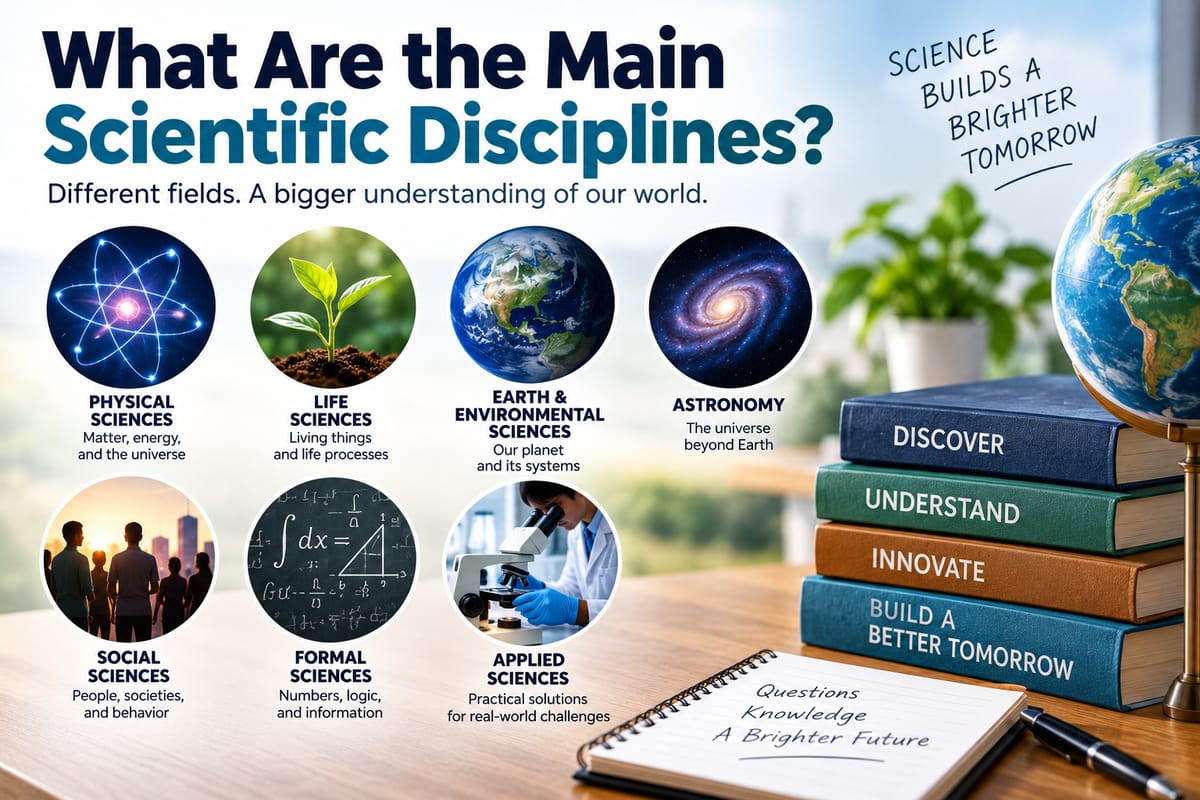
**What Are the Main Scientific Disciplines?
Science covers an enormous range of questions about the natural world, from the behavior of tiny particles to the evolution of life and the structure of distant galaxies. Because no single field can investigate every part of reality in the same way, science is divided into numerous disciplines and specialized areas.
These scientific disciplines have different subjects, methods, tools, and questions, but they are closely connected. Discoveries in one field can influence research in another, creating a broader understanding of how the world works.
The main scientific disciplines are commonly grouped into areas such as the physical sciences, life sciences, Earth and environmental sciences, social sciences, formal sciences, and applied sciences.
What Is a Scientific Discipline?
A scientific discipline is a specialized area of study focused on a particular group of questions, phenomena, or systems.
For example, biology focuses on living organisms, chemistry examines matter and its interactions, and astronomy investigates objects and phenomena beyond Earth.
Disciplines develop specialized:
- Research questions
- Methods
- Terminology
- Measurement techniques
- Theories
- Models
- Experimental approaches
- Areas of expertise
Despite these differences, scientific disciplines share a broader commitment to systematic investigation and evidence.
The Scientific Method and How Science Works provides a useful foundation for understanding how researchers formulate questions, gather evidence, test ideas, and develop explanations.
The Physical Sciences
The physical sciences investigate nonliving matter and energy and the fundamental processes that govern the physical universe.
Major physical science disciplines include:
- Physics
- Chemistry
- Astronomy
- Materials science
- Physical chemistry
- Geophysics
These fields often overlap considerably.
Physics
Physics studies matter, energy, motion, forces, space, and time. It attempts to describe fundamental relationships that govern physical phenomena.
Major areas include:
- Mechanics
- Thermodynamics
- Electromagnetism
- Optics
- Quantum physics
- Relativity
- Nuclear physics
- Particle physics
- Astrophysics
Physics can range from studying the movement of everyday objects to investigating the fundamental particles that make up matter.
Chemistry
Chemistry focuses on matter, its properties, its structure, and how substances interact and change.
Chemists study areas such as:
- Atoms and molecules
- Chemical reactions
- Materials
- Solutions
- Organic compounds
- Biochemical processes
- Energy changes
Chemistry connects the physical sciences with biology, medicine, materials science, environmental science, and many other fields.
Astronomy
Astronomy studies objects and phenomena beyond Earth’s atmosphere.
It includes research into:
- Stars
- Planets
- Moons
- Galaxies
- Nebulae
- Black holes
- Cosmic radiation
- The origin and evolution of the universe
The Complete Guide to Astronomy provides a broader look at this field and the major concepts used to understand the universe.
Astronomy also overlaps with physics through fields such as astrophysics and cosmology.
The Life Sciences
The life sciences focus on living organisms and the processes that allow life to exist, develop, reproduce, and interact with its environment.
Major life science disciplines include:
- Biology
- Zoology
- Botany
- Genetics
- Microbiology
- Ecology
- Biochemistry
- Physiology
- Evolutionary biology
- Neuroscience
Biology
Biology is the broad scientific study of life.
Biologists investigate organisms ranging from microscopic bacteria to plants, animals, and humans.
Questions in biology can involve:
- How cells function
- How organisms reproduce
- How traits are inherited
- How species evolve
- How organisms interact
- How ecosystems operate
Because biology covers such a large area, it contains numerous specialized disciplines.
Genetics
Genetics studies heredity and variation in living organisms.
Researchers investigate genes, DNA, chromosomes, mutations, and the ways biological characteristics are passed between generations.
Modern genetics connects with medicine, agriculture, evolutionary biology, biotechnology, and molecular biology.
Microbiology
Microbiology focuses on microscopic organisms and biological entities.
Research can involve:
- Bacteria
- Archaea
- Microscopic fungi
- Protozoa
- Viruses and other biological agents
Microbiology has applications in medicine, food production, environmental science, biotechnology, and public health.
Ecology
Ecology studies relationships between organisms and their environments.
Ecologists may examine individual organisms, populations, communities, ecosystems, and larger ecological systems.
The field helps scientists understand topics such as biodiversity, food webs, habitat changes, nutrient cycling, and interactions between species.
Earth and Environmental Sciences
Earth sciences investigate our planet, its physical structure, history, atmosphere, water systems, and natural processes.
Major disciplines include:
- Geology
- Geophysics
- Meteorology
- Oceanography
- Hydrology
- Climatology
- Environmental science
- Soil science
Geology
Geology studies Earth, including its rocks, minerals, structure, history, and geological processes.
Geologists investigate processes such as:
- Plate tectonics
- Volcanism
- Earthquakes
- Erosion
- Rock formation
- Mountain building
- Sedimentation
The Earth Science and Geology Complete Guide explores the major concepts involved in studying Earth’s structure and geological history.
Meteorology
Meteorology focuses on the atmosphere and weather.
Meteorologists study variables such as:
- Temperature
- Air pressure
- Humidity
- Wind
- Clouds
- Precipitation
The field is particularly important for weather forecasting and understanding atmospheric processes.
Oceanography
Oceanography is the scientific study of Earth’s oceans.
It includes several interconnected areas:
- Physical oceanography
- Chemical oceanography
- Biological oceanography
- Geological oceanography
Scientists investigate ocean currents, marine organisms, seafloor geology, seawater chemistry, and interactions between oceans and the atmosphere.
Hydrology
Hydrology focuses on water and its movement through Earth’s systems.
Hydrologists study:
- Rivers
- Lakes
- Groundwater
- Rainfall
- Water storage
- Runoff
- Water movement through landscapes
Hydrology is important for understanding freshwater availability, flooding, water resources, and environmental change.
Environmental Science
Environmental science combines knowledge from multiple scientific disciplines to study interactions between humans, organisms, and the physical environment.
Researchers may examine:
- Pollution
- Ecosystems
- Natural resources
- Biodiversity
- Environmental change
- Waste
- Water quality
- Air quality
Because environmental problems often involve multiple systems, environmental science is inherently interdisciplinary.
The Social Sciences
The social sciences investigate people, societies, institutions, relationships, and human behavior.
Major social science disciplines include:
- Psychology
- Sociology
- Economics
- Anthropology
- Political science
- Human geography
- Demography
Psychology
Psychology studies behavior and mental processes.
Researchers may investigate:
- Learning
- Memory
- Perception
- Emotion
- Development
- Social behavior
- Decision-making
Psychology includes both experimental research and applied areas focused on specific aspects of human behavior.
Sociology
Sociology examines societies, social relationships, institutions, and patterns of human interaction.
Sociologists may study:
- Families
- Communities
- Education
- Organizations
- Social inequality
- Culture
- Population changes
Economics
Economics studies how individuals, businesses, governments, and other organizations make decisions involving resources, production, distribution, and consumption.
It is commonly divided into areas such as:
- Microeconomics
- Macroeconomics
- Econometrics
- Development economics
- International economics
- Behavioral economics
Economics often uses mathematical models, statistical analysis, historical information, and empirical evidence.
Anthropology
Anthropology studies humans and human societies across time and cultures.
Depending on the tradition and institution, anthropology can encompass areas such as:
- Cultural anthropology
- Biological anthropology
- Archaeology
- Linguistic anthropology
The discipline provides perspectives on human evolution, cultural practices, societies, and human diversity.
The Formal Sciences
Formal sciences differ from disciplines that primarily investigate physical or social phenomena.
They focus on abstract structures, systems, relationships, and rules.
Major formal sciences include:
- Mathematics
- Statistics
- Logic
- Computer science
- Information theory
Mathematics
Mathematics studies quantities, structures, patterns, relationships, and abstract systems.
Major branches include:
- Algebra
- Geometry
- Calculus
- Number theory
- Probability
- Mathematical analysis
- Discrete mathematics
Mathematics provides tools used extensively throughout the natural and social sciences.
Statistics
Statistics focuses on collecting, analyzing, interpreting, and communicating data.
Statistical methods help researchers determine patterns, estimate relationships, quantify uncertainty, and evaluate evidence.
Statistics is used across fields ranging from biology and medicine to economics, engineering, environmental science, and psychology.
Computer Science
Computer science studies computation, algorithms, information, and computational systems.
Major areas include:
- Algorithms
- Programming
- Artificial intelligence
- Computer architecture
- Databases
- Cybersecurity
- Human-computer interaction
- Distributed systems
Computer science overlaps with mathematics, engineering, cognitive science, and many other disciplines.
The Applied Sciences
Applied sciences use scientific knowledge to address practical problems.
Rather than existing entirely separately from fundamental science, applied fields often build upon discoveries and methods developed in other disciplines.
Examples include:
- Medicine
- Engineering
- Agriculture
- Environmental technology
- Materials science
- Food science
- Public health
Medical Science
Medical science applies knowledge from biology, chemistry, genetics, physiology, and other fields to understanding health and disease.
Research can involve:
- Human anatomy
- Physiology
- Disease mechanisms
- Pharmacology
- Immunology
- Medical diagnostics
- Treatments
Medical research often requires collaboration across multiple scientific disciplines.
Agricultural Science
Agricultural science applies biological, environmental, chemical, and technological knowledge to food production and agricultural systems.
Researchers may investigate:
- Crop development
- Soil health
- Plant diseases
- Animal production
- Irrigation
- Agricultural ecosystems
- Food security
Engineering
Engineering applies scientific and mathematical principles to designing and developing technologies, structures, machines, and systems.
Major engineering disciplines include:
- Civil engineering
- Mechanical engineering
- Electrical engineering
- Chemical engineering
- Computer engineering
- Aerospace engineering
- Biomedical engineering
- Environmental engineering
Engineering frequently bridges scientific research and practical technological development.
Interdisciplinary Science
Modern scientific problems often do not fit neatly into one discipline.
Climate research, for example, can involve atmospheric science, oceanography, geology, biology, chemistry, physics, mathematics, and computer science.
Similarly, studying human health can require knowledge from:
- Biology
- Genetics
- Chemistry
- Physiology
- Psychology
- Statistics
- Computer science
This has led to the growth of interdisciplinary research, where scientists from different fields collaborate on shared questions.
How Scientific Disciplines Are Connected
Scientific disciplines can be viewed as parts of a larger network rather than isolated subjects.
Physics helps explain chemical processes. Chemistry helps explain biological reactions. Biology helps explain ecosystems. Earth science draws on physics, chemistry, and biology to investigate our planet.
Mathematics and statistics provide tools used throughout these fields.
This interconnectedness means that advances in one discipline can create new opportunities in another.
For example, improvements in computing have transformed scientific modeling, data analysis, astronomy, genetics, climate research, and many other areas.
Fundamental Versus Applied Research
Another useful distinction is between fundamental and applied research.
Fundamental research seeks to improve understanding of how something works, often without requiring an immediate practical application.
Applied research focuses more directly on solving a specific practical problem.
The two approaches are not completely separate. Fundamental discoveries can eventually produce important technologies, while practical problems can also generate new fundamental scientific questions.
Natural Sciences and Social Sciences
The natural sciences generally investigate the physical and biological world, while the social sciences focus primarily on humans and societies.
There can nevertheless be significant overlap.
For example, studying human behavior might involve psychology, neuroscience, biology, statistics, and sociology.
Similarly, environmental research can involve both natural science and social science because environmental systems are affected by human decisions, institutions, economies, and communities.
Why Scientific Classification Matters
Dividing science into disciplines helps researchers develop specialized knowledge.
It allows scientists to:
- Build expertise
- Develop specialized tools
- Create focused research programs
- Share knowledge with other specialists
- Train future researchers
- Develop precise terminology
- Address complex questions systematically
At the same time, classification should not create artificial barriers. Many of the most important scientific questions require researchers to work across traditional boundaries.
Choosing a Scientific Discipline
Students interested in science can explore disciplines by considering the types of questions they enjoy asking.
Someone fascinated by matter and energy might explore physics or chemistry. Someone interested in living organisms might consider biology. A person fascinated by Earth’s history could explore geology, while someone interested in space could study astronomy.
People interested in data, patterns, and abstract reasoning may gravitate toward mathematics or statistics. Those interested in human behavior and societies might explore psychology, sociology, economics, or anthropology.
There is also considerable flexibility. A career does not always remain within one narrow discipline, and many scientific professionals work at the intersection of multiple fields.
Science as a Connected System of Knowledge
The main scientific disciplines provide different perspectives on the world, but they ultimately contribute to a connected body of knowledge.
Physics investigates fundamental physical processes. Chemistry examines matter and its transformations. Biology studies life. Earth science explores our planet. Astronomy examines the universe beyond Earth. Social sciences investigate people and societies, while mathematics, statistics, and other formal sciences provide powerful tools for analyzing patterns and systems.
Applied sciences then use knowledge from these fields to address practical challenges.
As scientific questions become increasingly complex, the boundaries between disciplines can become less important than the connections between them. Understanding those connections helps reveal why science is not simply a collection of separate subjects, but a continually developing system for investigating the world and expanding human knowledge.




2 Comments
Micle harison
June 7, 2019Lorem ipsum dolor sit amet, usu ut perfecto postulant deterruisset, libris causae volutpat at est, ius id modus laoreet urbanitas. Mel ei delenit dolores.
John Doe
June 7, 2019Some consultants are employed indirectly by the client via a consultancy staffing company.