
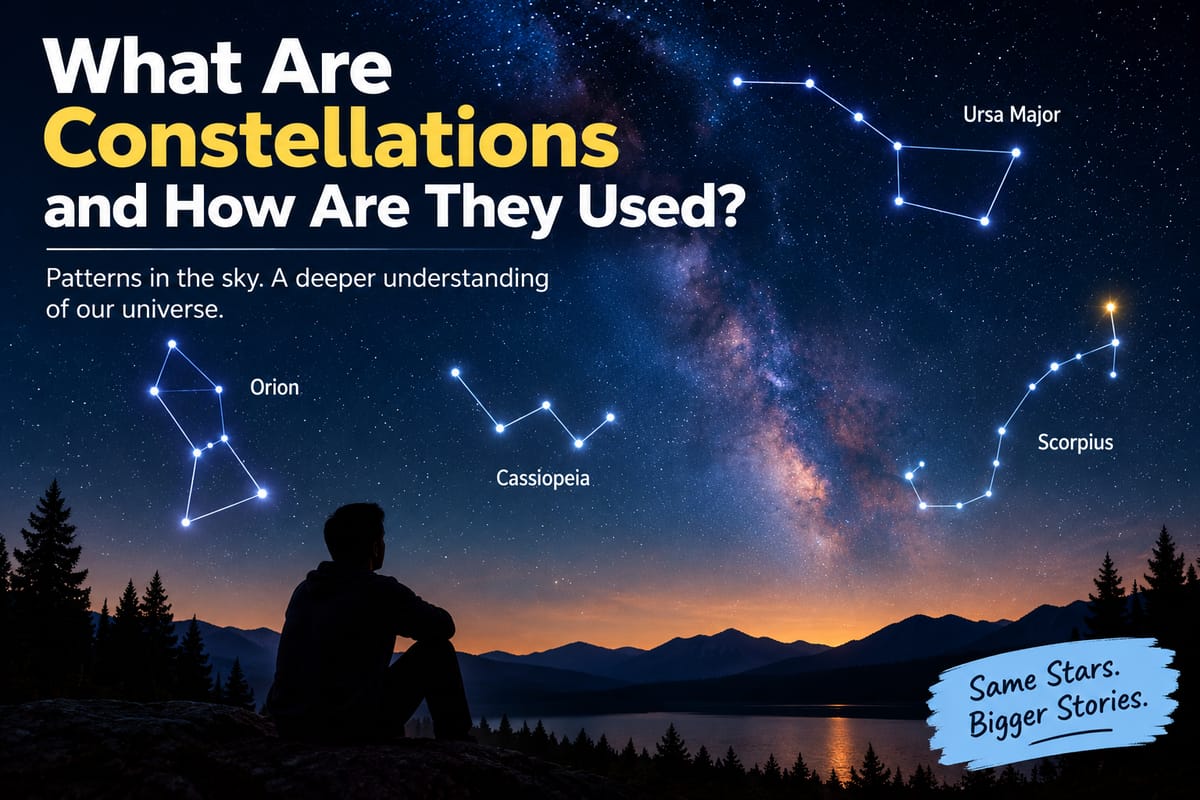
What Are Constellations and How Are They Used?
When people look up at the night sky, they often see familiar patterns among the stars. Some resemble animals, people, objects, or mythological figures, while others form shapes that have been recognized by different cultures for thousands of years. These patterns are called constellations.
Constellations are among the most recognizable features of the night sky, but they are not physical groups of stars held together in space. Instead, they are patterns that humans have identified from Earth. Their apparent shapes come largely from the way stars happen to appear positioned relative to one another from our viewpoint.
Constellations have played important roles in astronomy, navigation, calendars, mythology, and cultural traditions. Modern astronomers also use officially defined constellations as a practical way to divide the sky into recognizable regions.
What Is a Constellation?
A constellation is a defined region of the night sky associated with a recognizable pattern of stars.
The stars that make up a constellation may appear close together when viewed from Earth, but they can actually be separated by enormous distances. Two stars that seem next to each other in the sky may have little or no physical relationship with one another.
This is an important distinction between a constellation and a star cluster.
A star cluster is a physical collection of stars that are gravitationally related or originated from the same region of space. A constellation, by contrast, is primarily a visual and geographic concept used to describe an area of the sky.
To understand why constellations look the way they do, it helps to learn more about Everything You Need to Know About Stars, including how stars form, evolve, and differ in size, temperature, and brightness.
Why Do Constellations Look Like Shapes?
Constellation patterns are created by perspective.
Imagine looking at several streetlights from a long distance. From your position, they might appear to form a straight line or a recognizable shape. If you moved to another location, their arrangement could look completely different.
Stars work in a similar way.
Earth is located in one particular part of the Milky Way, and we observe stars from that position. Because the stars are at different distances, the patterns we see are essentially two-dimensional projections of a much more complicated three-dimensional arrangement.
For example, stars appearing close together in the sky may be dozens, hundreds, or even thousands of light-years apart.
The patterns therefore represent how stars appear arranged from Earth, rather than necessarily describing how they are physically arranged.
How Many Constellations Are There?
Modern astronomy officially recognizes 88 constellations covering the entire sky.
These 88 regions include familiar constellations such as:
- Orion
- Ursa Major
- Ursa Minor
- Cassiopeia
- Scorpius
- Taurus
- Leo
- Gemini
- Sagittarius
- Andromeda
The official boundaries of these constellations allow astronomers to identify specific locations in the sky consistently.
This means a constellation is more than just the collection of bright stars forming its familiar shape. In modern astronomy, it refers to an entire defined region of the celestial sphere.
The 88 constellations collectively cover the whole sky, so every star and deep-space object visible from Earth lies within the boundaries of one constellation.
Constellations and Asterisms Are Not the Same
A constellation should not be confused with an asterism.
An asterism is a recognizable pattern of stars that does not necessarily correspond to one of the 88 official constellations.
One of the best-known examples is the Big Dipper. It is a prominent seven-star pattern within the constellation Ursa Major, but it is not itself an official constellation.
Other familiar asterisms include the Summer Triangle and the Great Square of Pegasus.
This distinction is useful because many famous star patterns people identify in the sky are technically asterisms rather than constellations.
Where Did Constellations Come From?
The practice of identifying patterns in the stars is extremely old.
Ancient civilizations used the night sky to create stories, organize calendars, identify seasons, and navigate across land and sea. Different cultures developed their own interpretations of the stars, meaning that the same group of stars could represent completely different things to different societies.
Many modern Western constellation names have roots in ancient Greek and Roman traditions, although the history of these patterns is much broader.
Astronomical traditions developed independently in places such as:
- Mesopotamia
- Egypt
- China
- India
- Polynesia
- Indigenous societies throughout the Americas
- Africa
- The Middle East
These traditions demonstrate that humans have long used the sky as a way to organize observations of the natural world.
The broader subject of how humans study the universe, stars, planets, galaxies, and other celestial objects is explored in The Complete Guide to Astronomy.
Constellations and Mythology
Many constellations are connected to stories and legends.
For example, Orion is commonly associated with a hunter in Greek mythology. Scorpius is connected with a scorpion, while Andromeda is associated with a figure from Greek mythology.
These stories helped people remember star patterns and pass astronomical knowledge from one generation to another.
However, the mythology associated with constellations is cultural rather than scientific. The stars themselves do not form the characters or objects represented in the stories.
Constellations are therefore an interesting intersection of astronomy, history, culture, and storytelling.
How Constellations Help Astronomers Locate Objects
One of the most important modern uses of constellations is helping astronomers describe where objects appear in the sky.
Because the sky is divided into 88 recognized regions, astronomers can identify the general location of an object by naming the constellation in which it appears.
For example, instead of describing a distant galaxy only by giving complicated coordinates, an astronomer might say that the object appears in the constellation Andromeda.
This provides a convenient reference point for observers.
Professional astronomers rely on more precise coordinate systems for scientific measurements, but constellation boundaries remain useful for communicating locations in the sky.
Constellations and Navigation
Before modern navigation technologies became widespread, stars were essential navigational tools.
People traveling across oceans and deserts could use particular stars and constellations to determine direction and estimate their position.
In the Northern Hemisphere, the North Star, Polaris, has been especially important because it appears close to the north celestial pole. Its position makes it useful for identifying north.
Constellations can also help observers locate important stars. For example, the stars of the Big Dipper can be used as a guide toward Polaris.
In the Southern Hemisphere, different stars and patterns are used for orientation, including the Southern Cross.
Although modern ships, aircraft, and spacecraft can use sophisticated navigation systems, celestial navigation remains an important example of how observations of the sky can be converted into practical information.
Constellations Help Identify Seasons
The appearance of particular constellations changes throughout the year.
This happens because Earth orbits the Sun. As Earth moves along its orbit, the nighttime side of our planet faces different directions in space.
As a result, some constellations are prominent during certain months but difficult or impossible to see at other times of the year.
This seasonal movement made constellations valuable to ancient societies.
The appearance of particular star patterns could help people recognize changes in seasons, organize agricultural activities, and track the passage of time.
Constellations and the Zodiac
The zodiac constellations are associated with the region of the sky through which the Sun, Moon, and planets appear to move as seen from Earth.
This region is connected to the plane of Earth’s orbit around the Sun.
The traditional zodiac includes constellations such as:
- Aries
- Taurus
- Gemini
- Cancer
- Leo
- Virgo
- Libra
- Scorpius
- Sagittarius
- Capricornus
- Aquarius
- Pisces
The zodiac is important in astronomy because the planets and other objects of the solar system appear against these background regions of stars.
It is also important to distinguish astronomy from astrology. Astronomy is a scientific discipline concerned with studying celestial objects and physical processes, while astrology assigns supposed human or predictive meanings to celestial positions.
How Constellations Differ From Galaxies
Constellations and galaxies operate on completely different scales.
A constellation is an apparent pattern or defined region of the sky as viewed from Earth. A galaxy is a massive physical system containing stars, gas, dust, dark matter, and other components bound together by gravity.
The Milky Way, for example, is a galaxy containing enormous numbers of stars. Some of the stars we see in constellations belong to the Milky Way.
Other objects visible within constellation boundaries can be much farther away, including galaxies beyond the Milky Way.
The enormous scale of these systems becomes clearer when exploring The Complete Guide to Galaxies.
Why Constellation Shapes Change Over Time
Constellations may appear permanent to human observers, but the stars themselves are moving.
Stars travel through space at different speeds and in different directions. Over extremely long periods, these movements gradually change their apparent positions relative to one another.
This means that a constellation viewed hundreds of thousands or millions of years in the future would not necessarily have exactly the same appearance it has today.
The changes are generally too slow to notice during an ordinary human lifetime, which is why constellations can seem fixed.
Earth’s own motion also affects our observations. Earth’s rotation creates the daily apparent movement of the sky, while Earth’s orbit around the Sun produces seasonal changes in which constellations are visible at night.
Constellations and Celestial Coordinates
Modern astronomy uses coordinate systems to describe precise positions in the sky.
Two important measurements are right ascension and declination.
They are roughly comparable to longitude and latitude on Earth:
- Right ascension measures position eastward around the celestial sphere.
- Declination measures position north or south of the celestial equator.
Constellation boundaries provide another layer of organization.
Together, these systems allow astronomers to identify and communicate the locations of stars, planets, galaxies, nebulae, and other objects.
How Constellations Help Amateur Stargazers
Constellations are particularly useful for people learning how to observe the night sky.
Instead of trying to identify thousands of individual stars, a beginner can first learn several prominent patterns.
Once a constellation is recognized, it can serve as a sky map landmark.
For example, finding Orion can help an observer locate several interesting celestial objects nearby. Recognizing Ursa Major can help with finding Polaris. Learning Scorpius can provide a useful reference for exploring rich regions of the Milky Way.
This process is often called star hopping, where observers move from a familiar star or constellation to increasingly faint or difficult-to-find objects.
Constellations and Space Exploration
Constellations can also appear in discussions of space exploration because spacecraft, planets, stars, and deep-space targets are often described in relation to regions of the sky.
For example, astronomers planning observations with space telescopes may identify targets by their celestial coordinates and constellation locations.
Constellations do not determine where spacecraft travel, however. Space missions are planned using precise orbital mechanics, trajectories, navigation data, and physical measurements rather than simply traveling toward a constellation.
A constellation is a useful reference in the sky, not a destination in space.
Can You See All 88 Constellations From One Place?
No.
Earth’s curved surface means that observers at different latitudes see different portions of the sky.
Some constellations are primarily associated with the Northern Hemisphere, while others are easier or only possible to see from southern latitudes. Some constellations can be observed from both hemispheres, depending on the observer’s location.
For someone near the equator, a large portion of both the northern and southern skies can be observed throughout the year.
Even when a constellation is technically above the horizon, local conditions such as mountains, buildings, trees, light pollution, clouds, and atmospheric conditions can make it difficult to see.
How Light Pollution Affects Constellations
Modern cities can make constellation viewing much more difficult.
Artificial light scattered through the atmosphere brightens the night sky, reducing the visibility of faint stars.
Under a dark sky, an observer may see a large number of stars and clearly recognize complex patterns. In a brightly lit urban environment, only the brightest stars may remain visible.
This is why many amateur astronomers travel away from cities to darker locations.
Dark skies do more than improve the appearance of constellations. They also make it easier to observe the Milky Way, nebulae, star clusters, and distant galaxies.
Constellations Provide a Human-Friendly Map of the Universe
The universe is far too large and complex to observe without some method of organization.
There are enormous numbers of stars within our galaxy alone, along with planets, nebulae, star clusters, black holes, galaxies, and other objects spread across immense distances.
The known universe extends vastly beyond the Milky Way. The scale involved is explored further in How Large Is the Known Universe?.
Constellations do not solve the problem of cosmic scale, but they give humans a familiar framework for organizing one small part of what we see.
They turn the apparently chaotic night sky into recognizable regions and patterns.
Why Constellations Still Matter Today
Constellations began as human interpretations of the stars, but their usefulness has lasted into modern astronomy.
They help people:
- Learn the night sky
- Identify prominent stars
- Find celestial objects
- Describe regions of the sky
- Understand seasonal changes
- Practice celestial navigation
- Connect astronomy with history and culture
- Communicate the general location of astronomical targets
The most important thing to remember is that constellations are patterns and regions seen from Earth, not necessarily physical groups of related stars.
Their familiar shapes are products of perspective, while their modern boundaries provide a standardized map of the celestial sphere. From ancient navigation and mythology to modern astronomical observation, constellations remain one of the simplest ways humans organize and understand the night sky.




2 Comments
Micle harison
June 7, 2019Lorem ipsum dolor sit amet, usu ut perfecto postulant deterruisset, libris causae volutpat at est, ius id modus laoreet urbanitas. Mel ei delenit dolores.
John Doe
June 7, 2019Some consultants are employed indirectly by the client via a consultancy staffing company.