
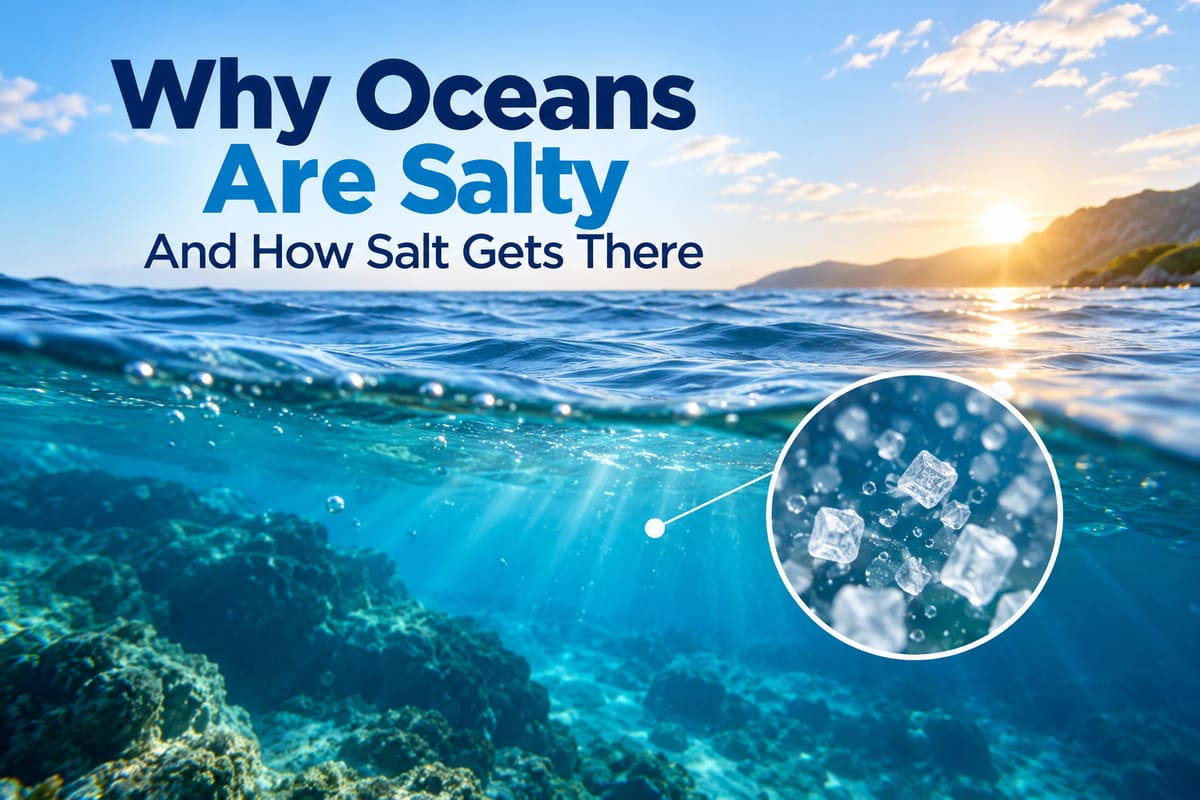
Why Oceans Are Salty and How Salt Gets There
Look out across an ocean and it can seem like an enormous body of ordinary water. Yet seawater is very different from the freshwater found in most lakes, rivers, and streams. Dissolved minerals and salts give the ocean its distinctive chemistry, allowing marine ecosystems to function while also influencing how water moves through Earth’s climate system.
But where did all that salt come from?
The answer is not as simple as saying that rivers carry salt into the sea. Rivers are an important part of the story, but volcanic activity, weathering of rocks, hydrothermal activity beneath the seafloor, and chemical reactions within the ocean have all contributed to its saltiness. At the same time, processes continually remove dissolved substances from seawater, helping keep ocean chemistry within a relatively stable range over long periods.
Understanding why oceans are salty provides a fascinating look at how Earth’s land, atmosphere, water, and geological systems interact.
What Makes Ocean Water Salty?
Ocean water contains many dissolved substances, but sodium and chloride are the two most abundant ions. Together, they form the primary components of ordinary table salt, sodium chloride.
Seawater also contains smaller amounts of substances such as:
- Magnesium
- Sulfate
- Calcium
- Potassium
- Bicarbonate
- Bromide
- Dissolved gases
- Trace metals and other minerals
When scientists refer to ocean salinity, they are describing the concentration of dissolved salts and other dissolved materials in seawater.
Average ocean salinity is roughly 35 parts per thousand, meaning that about 35 grams of dissolved salts are present in a kilogram of seawater. The actual value varies from place to place because evaporation, precipitation, river runoff, ice formation, and ocean circulation continually alter the concentration of dissolved substances.
Saltiness therefore isn’t perfectly uniform throughout the global ocean.
Where Did the Ocean’s Salt Come From?
The salt in the ocean has several sources, and Earth’s geological history is central to the explanation.
One of the most important processes is the gradual breakdown of rocks on land.
Rainwater is naturally slightly acidic because it absorbs carbon dioxide from the atmosphere and soil. As rain falls onto rocks and moves across the landscape, it can chemically react with minerals.
This process, known as chemical weathering, releases ions from rocks.
Rivers then transport some of these dissolved materials toward the ocean.
Over extremely long periods, these processes have helped transfer minerals from continental rocks into the world’s oceans.
This is one reason understanding Earth science and geology is important when investigating something as familiar as seawater. Ocean chemistry is connected to the rocks, minerals, and geological processes operating across the planet.
Rivers Carry Dissolved Minerals to the Sea
A river may look fresh and clear, but freshwater is not chemically pure.
As water flows over and through soil and rock, it picks up dissolved minerals. The quantities are usually small enough that people do not notice them, but rivers collectively transport enormous amounts of dissolved material toward the oceans.
This creates an important connection between continents and marine environments.
The basic pathway can be simplified as:
Rock → Weathering → Dissolved minerals → Rivers → Ocean
Not every substance transported by rivers remains in seawater indefinitely. Some are incorporated into marine sediments, absorbed by organisms, deposited chemically, or otherwise removed from the water.
The relationship between rivers, groundwater, lakes, wetlands, and oceans is part of the broader water system described in how Earth’s freshwater systems work.
Rain Helps Break Down Rocks
Rain plays a surprisingly important role in the long-term chemistry of the ocean.
Pure water is relatively unreactive compared with water containing dissolved carbon dioxide and other substances. When atmospheric carbon dioxide dissolves in rainwater, it contributes to the formation of weak carbonic acid.
As this water encounters exposed rocks, it can help dissolve certain minerals.
The resulting dissolved ions can enter streams and rivers and eventually reach the sea.
This process happens slowly. A single rainfall event does not noticeably increase ocean salinity. Instead, countless weathering reactions occurring across continents over millions of years contribute to the movement of minerals into the global ocean.
Volcanoes Also Contribute to Ocean Chemistry
Volcanic activity is another part of the story.
Volcanoes release gases and minerals into the atmosphere and surrounding environment. Underwater volcanic activity can also introduce chemicals directly into seawater.
Hydrothermal vents on the ocean floor are particularly important to ocean chemistry. These systems occur where seawater circulates through hot rocks beneath the seafloor, becomes chemically altered, and emerges carrying dissolved substances.
Hydrothermal activity can add and remove various chemical elements from seawater.
This demonstrates that the ocean is not simply a passive container collecting material from rivers. It is an active chemical environment where water continuously interacts with rocks, sediments, minerals, organisms, and the seafloor.
Does Evaporation Make the Ocean Salty?
Evaporation is crucial to understanding why the ocean remains salty.
When seawater evaporates, individual water molecules enter the atmosphere as water vapor. Most dissolved salts, however, do not evaporate with the water.
That means the salts remain behind.
If a small amount of seawater is placed in a container and allowed to evaporate completely, the remaining material includes the dissolved salts that were originally present.
The same principle operates naturally across the oceans.
However, evaporation does not explain the original arrival of salt in the ocean. Instead, it concentrates dissolved substances that are already present.
This is particularly important in areas where evaporation is greater than precipitation.
Why Doesn’t the Ocean Become Saltier Forever?
If rivers continually deliver dissolved minerals to the ocean and evaporation leaves salts behind, it might seem that ocean salinity should increase without limit.
It doesn’t.
The ocean has many mechanisms that remove dissolved substances.
Some dissolved ions become incorporated into minerals and sediments. Marine organisms use certain elements to build shells, skeletons, and other structures. Chemical reactions at the seafloor can also remove substances from seawater.
Sediments accumulating on the ocean floor can eventually become part of Earth’s geological record.
Other processes return materials to the environment through geological activity.
The result is a dynamic system in which substances enter and leave the ocean over different timescales.
The Ocean Is Part of Earth’s Larger Natural Cycles
Salt doesn’t move through the environment independently of water and geology.
Water evaporates from the ocean, enters the atmosphere, falls as precipitation, flows across continents, moves through groundwater systems, and eventually returns to the sea.
Meanwhile, rocks are weathered, minerals are transported, sediments accumulate, and geological processes recycle Earth’s materials.
These interactions are examples of the interconnected systems described in Earth’s major natural cycles.
The water cycle, carbon cycle, rock cycle, and other natural cycles overlap constantly. Changes in one part of Earth’s system can influence processes elsewhere.
Why Isn’t Every Ocean Equally Salty?
Ocean salinity varies geographically.
Several factors influence how salty seawater becomes, including:
- Evaporation: Removes water while leaving most dissolved salts behind.
- Precipitation: Adds freshwater and can lower surface salinity.
- River runoff: Introduces freshwater and dissolved minerals.
- Ice formation: When seawater freezes, much of the salt is excluded from the forming ice, leaving the surrounding water saltier.
- Melting ice: Adds freshwater and can reduce local salinity.
- Ocean circulation: Moves water with different temperatures and salinities around the planet.
For example, regions with intense evaporation and relatively little rainfall can have particularly salty surface waters. Areas receiving substantial rainfall or freshwater runoff can have lower surface salinity.
Ocean currents then transport these different water masses across enormous distances.
Why Ocean Salinity Matters for Climate
Salt does more than give seawater its taste.
Salinity affects the density of seawater, alongside temperature. Differences in density help drive large-scale ocean circulation.
When seawater becomes colder or saltier, its density can increase. In certain parts of the ocean, dense water can sink, contributing to deep-ocean circulation.
This movement is part of the complex system through which oceans redistribute heat around the planet.
The relationship between seawater, atmospheric conditions, currents, and climate is explored more broadly in how oceans shape Earth’s climate and environment.
Ocean circulation can transport heat from one region to another, influence regional climates, move nutrients, and connect distant marine ecosystems.
Salt and Marine Life
Marine organisms have evolved to live within the chemical conditions of seawater.
Fish, crustaceans, mollusks, plankton, algae, and countless other organisms have physiological mechanisms that help them regulate water and dissolved ions.
For many marine species, maintaining the right balance of salts inside and outside their cells is essential.
Some organisms also extract particular dissolved substances from seawater.
For example, many shell-forming organisms use calcium and carbonate to construct shells or skeletons. When organisms die, some of these materials can become incorporated into sediments.
Over geological time, biological activity can therefore influence the movement and storage of elements in the marine environment.
Why Freshwater Doesn’t Taste Salty Like the Ocean
Freshwater is not necessarily free of dissolved minerals.
Groundwater and rivers can contain calcium, magnesium, bicarbonate, sodium, and other dissolved substances. However, their concentrations are generally much lower than those found in seawater.
The difference is largely a matter of concentration and residence time.
Water continually moves through freshwater environments, while the ocean serves as a massive long-term reservoir where dissolved materials can accumulate and circulate.
Freshwater also has much shorter average residence times in many parts of the hydrological system compared with the enormous reservoirs represented by the oceans.
Can the Ocean’s Salt Be Removed?
Yes, and nature removes salt from seawater in several ways.
Some salts become part of mineral deposits or marine sediments. Biological organisms incorporate certain dissolved elements into their bodies and structures. Chemical reactions involving seawater and rocks can also remove ions from solution.
Humans can remove salt through technologies such as desalination.
Desalination separates dissolved salts from seawater to produce water with much lower concentrations of dissolved minerals. Technologies such as reverse osmosis use membranes to separate salts and other dissolved substances from water.
Natural removal and human desalination operate on very different scales, however. Modern desalination is primarily designed to produce usable freshwater for people rather than alter the salinity of the world’s oceans.
The Long Geological Story Behind Salty Seas
The ocean’s saltiness is the result of processes operating over enormous spans of time.
Rain interacts with rocks. Rivers transport dissolved materials. Volcanoes and hydrothermal systems alter seawater chemistry. Organisms incorporate elements into biological structures. Sediments store minerals. Chemical reactions remove and transform dissolved substances.
None of these processes operates in isolation.
Together, they form part of Earth’s constantly changing geological and environmental system.
That is why a seemingly simple question — why are oceans salty? — ultimately leads into the study of weathering, rivers, geology, climate, biology, chemistry, and Earth’s natural cycles.
What the Salt in the Ocean Reveals About Earth
The saltiness of the oceans is essentially a record of Earth’s ongoing interactions.
Every river carrying dissolved minerals toward the sea, every rainfall event weathering exposed rock, every hydrothermal vent altering seawater, and every layer of marine sediment contributes to a much larger planetary system.
The ocean may appear relatively stable from the shoreline, but its chemistry is constantly being shaped by processes occurring across land, beneath the seafloor, in the atmosphere, and within living organisms.
Ocean salt is therefore more than something that makes seawater taste different from freshwater. It is one visible result of the long geological and chemical history of our planet.




2 Comments
Micle harison
June 7, 2019Lorem ipsum dolor sit amet, usu ut perfecto postulant deterruisset, libris causae volutpat at est, ius id modus laoreet urbanitas. Mel ei delenit dolores.
John Doe
June 7, 2019Some consultants are employed indirectly by the client via a consultancy staffing company.