
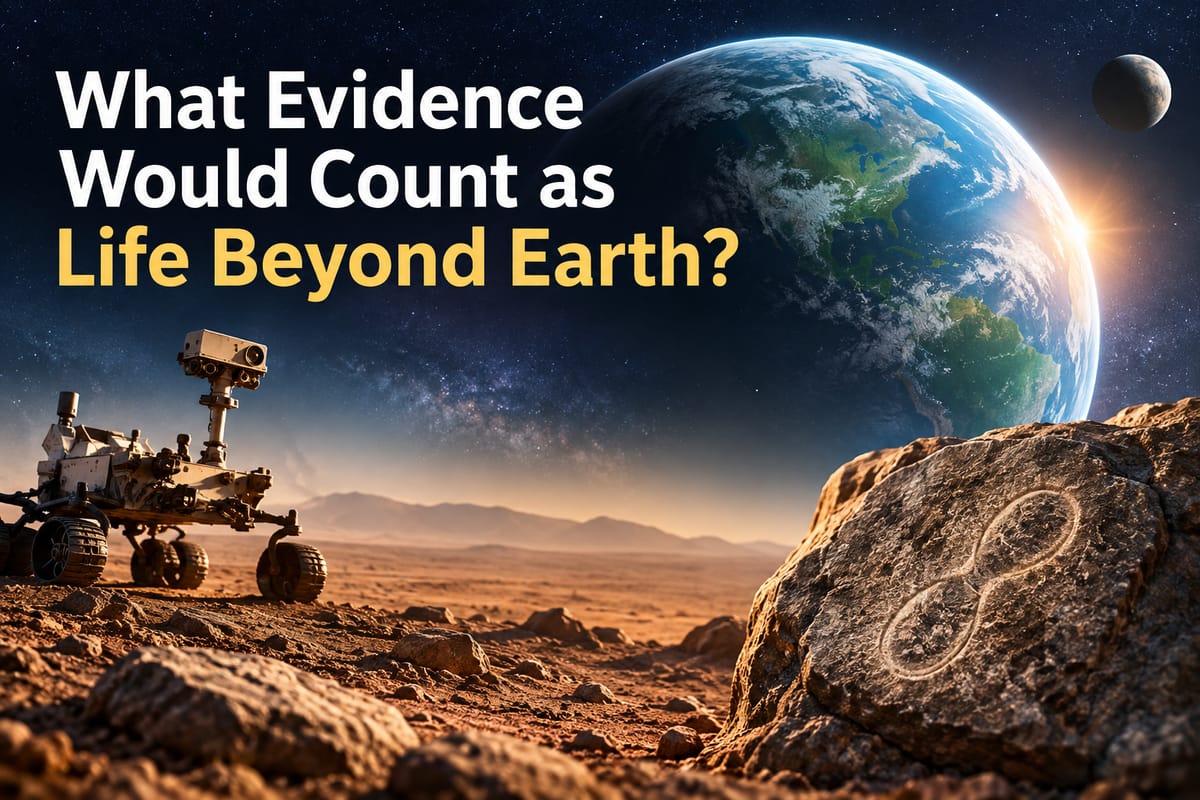
**What Evidence Would Count as Life Beyond Earth?
The discovery of life beyond Earth would be one of the most consequential findings in human history. Yet proving that life exists somewhere else in the universe would require much more than finding an unusual chemical, a promising planet, or a signal that scientists cannot immediately explain.
Researchers looking for extraterrestrial life are therefore focused on a more difficult question: What evidence would actually count as convincing proof?
The answer depends on the type of life being investigated and where the evidence is found. A possible microorganism preserved in an ancient Martian rock would require a different investigation from a chemical signature detected in the atmosphere of a distant exoplanet. Likewise, a repeating radio signal would need to be evaluated differently from biological material returned to Earth.
The central principle is that extraordinary claims require evidence that can survive careful testing, independent analysis, and attempts to find alternative explanations.
What Scientists Mean by Evidence of Life
Scientists generally distinguish between evidence that a location could support life, evidence that something might be biological, and evidence that directly demonstrates biological activity.
These are very different levels of evidence.
Finding liquid water, organic molecules, or an atmosphere containing potentially useful gases can establish that an environment has ingredients associated with life. It does not, by itself, demonstrate that organisms are present.
For example, organic molecules can be produced through non-biological chemical reactions. Water can exist without life. Even gases commonly associated with biology can sometimes be generated through geological or atmospheric processes.
This is why astrobiology involves much more than simply searching for familiar signs of Earth-like organisms. The broader field examines how life might originate, survive, evolve, and leave detectable traces in different environments. A useful overview is the Complete Guide to Astrobiology and Life in Space.
A Stronger Case: Multiple Independent Clues
One of the strongest approaches would be to find several different observations that point toward the same biological explanation.
Imagine scientists studying the atmosphere of a distant planet. They detect a gas that could potentially be produced by organisms. On its own, that observation might be interesting but inconclusive.
Scientists would then ask whether geological activity, stellar radiation, photochemical reactions, or other known processes could produce the same signal.
If those explanations could be ruled out and additional atmospheric characteristics independently supported biological activity, the case would become substantially stronger.
The important factor is not simply the number of clues. The clues should ideally be independent and mutually reinforcing.
A collection of measurements that all originate from the same uncertain assumption is less persuasive than several observations produced by different methods.
Biosignatures Could Provide Important Clues
A biosignature is a measurable feature that could provide evidence of past or present biological activity.
Biosignatures can take many forms. They might include:
- Particular chemical compounds
- Unusual combinations of atmospheric gases
- Molecular structures associated with biological processes
- Microscopic structures resembling fossils
- Chemical patterns showing possible biological selection
- Changes in an environment that are difficult to explain without biology
However, scientists must distinguish between a potential biosignature and a confirmed biosignature.
A molecule that is commonly associated with life on Earth is not automatically proof of life elsewhere. The chemistry of another planet could produce the same molecule through entirely different processes.
That is why researchers increasingly consider the entire environmental context rather than searching for one supposedly definitive molecule.
Why Organic Molecules Would Not Be Enough
Organic chemistry is central to life as we know it, but finding organic molecules elsewhere would not settle the question of whether life exists.
Organic compounds have been detected in space, meteorites, planetary environments, and other astronomical settings. Their existence demonstrates that complex carbon chemistry is not unique to living organisms.
The crucial question would be whether the molecules exhibit characteristics that are difficult to explain through abiotic chemistry.
For instance, scientists might examine molecular abundance, distribution, structural complexity, or relationships between different compounds. They could then compare the observations with laboratory experiments and models of non-biological chemistry.
The more successfully alternative explanations are eliminated, the more meaningful the evidence becomes.
Finding Water Would Be Exciting but Not Conclusive
Water is one of the most important ingredients in the search for potentially habitable environments.
Scientists therefore pay close attention to planets, moons, and other worlds where liquid water may have existed or could exist beneath a surface.
But water is not a biological signature.
Earth has abundant water because of its planetary history and physical conditions, while many nonliving environments can contain water as well. Consequently, discovering an underground ocean or evidence of ancient rivers would establish an important environmental fact rather than proof of extraterrestrial organisms.
It could, however, identify a location where biological activity deserves closer investigation.
What About a Possible Fossil?
A fossil-like structure could provide stronger evidence if it were found in material from another world.
Suppose a spacecraft returned an ancient rock containing microscopic structures that appeared similar to fossils. Scientists would need to determine whether the structures were actually produced by organisms or whether unusual mineral processes could create the same shapes.
That distinction can be extremely difficult.
On Earth, researchers sometimes debate whether structures preserved in ancient rocks are biological or geological. The problem becomes even harder when scientists have only a small sample from another planet.
A convincing extraterrestrial fossil claim would therefore likely require several lines of evidence, such as morphology, chemistry, mineral context, and comparisons with experimentally produced non-biological structures.
Direct Detection of Biological Activity
Evidence of ongoing biological activity could potentially be more compelling than a structure that merely resembles a fossil.
For example, scientists might observe a chemical transformation occurring in an extraterrestrial environment that appears to be maintained by metabolism.
The challenge would again be demonstrating that the process cannot reasonably be explained through known non-biological chemistry.
Researchers would need measurements showing that the phenomenon is repeatable, consistent, and associated with characteristics expected from a biological system.
If an instrument could directly observe cells or cell-like systems undergoing biological processes, the evidence could become considerably stronger.
A Sample Returned to Earth Could Change the Investigation
Material brought back from another world would give scientists an opportunity to conduct experiments that are difficult or impossible with remote spacecraft instruments.
Laboratories on Earth could analyze a sample using many different techniques and allow independent research teams to examine portions of the material.
This could be particularly important if the sample contained complex organic structures, unusual isotopic patterns, or microscopic formations that might indicate ancient life.
However, returning material to Earth would also create another major scientific responsibility: contamination control.
Scientists would need to establish that biological material was genuinely extraterrestrial rather than introduced during collection, transport, handling, or laboratory analysis.
Exoplanet Atmospheres Present a Different Challenge
Thousands of planets have been discovered beyond the Solar System, creating new opportunities to search for potentially habitable environments. Understanding How Exoplanets Are Discovered and Studied helps explain why atmospheric observations have become such an important part of modern planetary science.
For distant worlds, scientists generally cannot collect physical samples. Instead, they can study the light passing through or reflected by a planet’s atmosphere.
This can reveal information about atmospheric gases and other properties.
The difficult part is interpretation.
A detected gas may have multiple possible origins. Stellar activity, volcanic processes, surface chemistry, atmospheric circulation, and radiation can all affect planetary atmospheres.
Consequently, researchers need detailed models of the planet and its star before deciding whether an atmospheric signal could plausibly have a biological explanation.
Could Intelligent Life Be Detected Differently?
The search for technological civilizations follows a somewhat different path.
Instead of looking for biological molecules, scientists may search for technosignatures—observable evidence that technology exists or once existed.
Possible examples include unusual radio transmissions, highly structured signals, artificial-looking electromagnetic emissions, or other phenomena that cannot be readily explained by natural processes.
A mysterious signal, however, would not automatically mean aliens had been detected.
Scientists would first investigate whether the signal originated from Earth-based technology, satellites, instrumentation, known astronomical objects, or an unusual natural phenomenon.
A genuine technological signal would need to demonstrate characteristics that distinguish it convincingly from natural and human-made sources.
Repetition and Verification Would Matter
A single unexpected observation can be caused by an instrument problem, data-processing error, interference, contamination, or an unusual natural event.
Repeated observations provide an opportunity to test whether the phenomenon is real.
Scientists could attempt to observe the same signal, chemical signature, or physical structure using different instruments and independent research teams.
Independent confirmation is particularly important because scientific discoveries become more credible when researchers who were not involved in the original observation can reproduce or validate the result.
This is part of the broader process described in the Scientific Method and How Science Works.
Ruling Out False Positives Is Essential
Perhaps the most important requirement for claiming extraterrestrial life is the systematic elimination of false positives.
A false positive occurs when an observation appears to indicate life but actually has a non-biological explanation.
Scientists therefore ask questions such as:
- Could geology produce this signal?
- Could atmospheric chemistry explain it?
- Could radiation generate the observed molecules?
- Could the instrument have introduced an error?
- Could contamination account for the result?
- Has the observation been independently reproduced?
- Are there competing explanations that fit the evidence equally well or better?
The search for life is consequently not simply about finding evidence that supports a biological hypothesis. It is also about aggressively testing explanations that do not involve life.
What Would Count as Especially Convincing?
There is no single universally guaranteed observation that would settle every possible extraterrestrial-life scenario. Different discoveries would require different forms of verification.
Nevertheless, evidence would generally become much more compelling when it has several characteristics:
- Directness: The observation is closely connected to biological activity rather than merely associated with environments where life might exist.
- Specificity: Known non-biological processes struggle to explain the observation.
- Repeatability: The result can be observed again.
- Independent confirmation: Multiple teams or instruments obtain consistent results.
- Multiple lines of evidence: Chemistry, physical structure, environmental context, and other observations support the same interpretation.
- Contamination control: Scientists can demonstrate that the evidence did not originate on Earth.
- Predictive power: A biological explanation successfully predicts additional observations that are subsequently detected.
The combination matters because no single clue is necessarily decisive.
The Search Is Designed to Challenge Its Own Discoveries
Scientists searching for life beyond Earth face an unusual problem: they are looking for something whose existence has not yet been demonstrated.
That makes skepticism a useful part of the process.
Researchers must be willing to ask whether an exciting observation is actually evidence of life or simply an unexpected feature of nature. They must test competing explanations, improve instruments, conduct laboratory experiments, and seek independent confirmation.
This approach is already central to How Scientists Search for Life Beyond Earth.
The goal is not to make every strange observation fit the idea of extraterrestrial life. The goal is to determine what explanation best survives rigorous testing.
The Evidence May Arrive Gradually
The first convincing indication of life beyond Earth may not resemble the dramatic discovery imagined in science fiction.
It could begin with an unusual chemical measurement, followed by additional observations that make alternative explanations increasingly difficult to sustain. Years of laboratory work and independent analysis might then be required before scientists reach a broad consensus.
Alternatively, a future spacecraft could potentially encounter a biological system directly, producing evidence that is much easier to interpret.
Either way, the scientific significance would come from the strength of the evidence rather than the excitement surrounding the discovery.
When a Possibility Becomes a Discovery
Finding a potentially habitable world is not the same as finding life. Detecting an organic molecule is not the same as detecting an organism. Even identifying a possible biosignature is not necessarily enough.
The strongest case for life beyond Earth would emerge when observations repeatedly point toward biological activity while known non-biological explanations fail to account for the complete set of evidence.
That standard may make the search slower and more demanding, but it also provides a way to distinguish an extraordinary discovery from an extraordinary-looking observation. If humanity eventually confirms life beyond Earth, the most important evidence may be not one spectacular clue, but a body of independently tested observations that leaves increasingly little room for another explanation.


2 Comments
Micle harison
June 7, 2019Lorem ipsum dolor sit amet, usu ut perfecto postulant deterruisset, libris causae volutpat at est, ius id modus laoreet urbanitas. Mel ei delenit dolores.
John Doe
June 7, 2019Some consultants are employed indirectly by the client via a consultancy staffing company.