
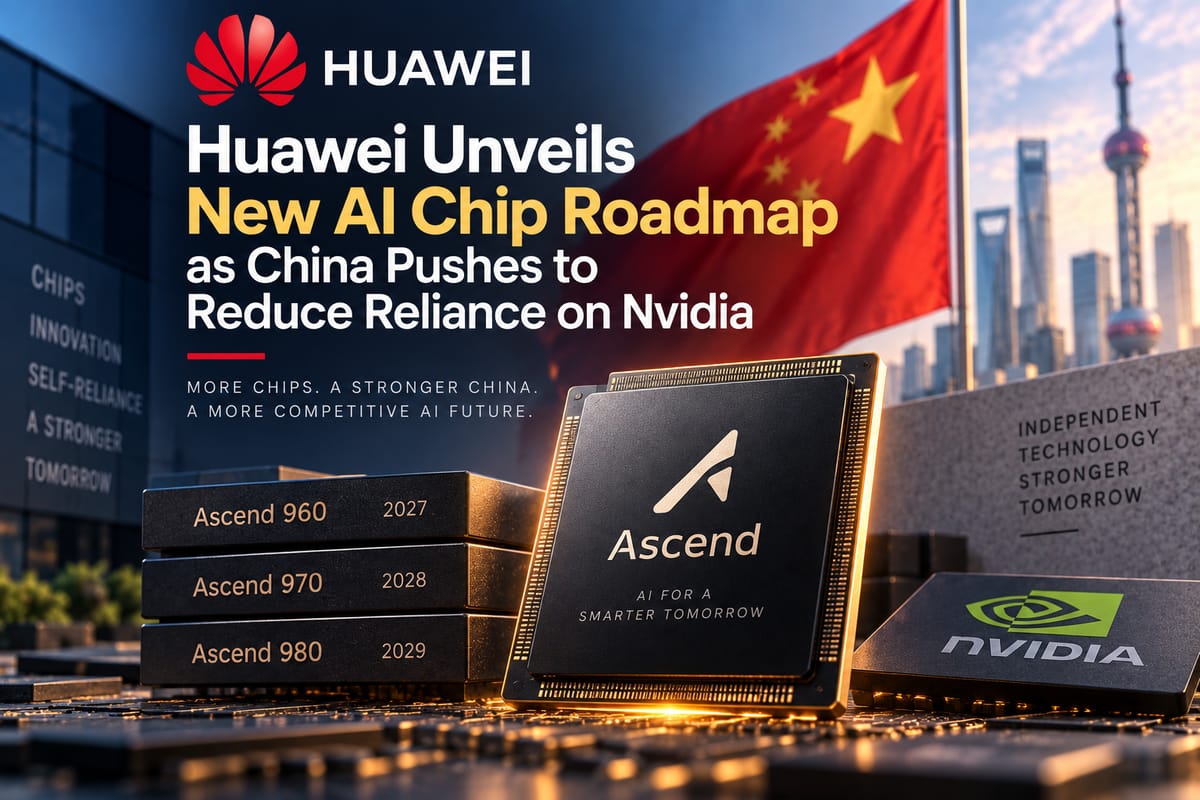
Huawei Unveils New AI Chip Roadmap as China Pushes to Reduce Reliance on Nvidia
Huawei is accelerating its artificial intelligence chip roadmap as China intensifies efforts to build a more self-reliant AI computing industry and reduce its dependence on Nvidia’s advanced processors.
At its Huawei Connect conference in Shanghai, the company unveiled an expanded roadmap for its Ascend AI chips and related computing systems, bringing forward the launch of its next-generation Ascend 960DT processor to the first quarter of 2027. Huawei also plans to release the Ascend 960PR in the third quarter of 2027, followed by the Ascend 970 in 2028 and Ascend 980 in 2029.
The announcements come as demand for AI computing continues to grow and U.S. restrictions limit Chinese access to some of the most advanced AI chips and semiconductor manufacturing technologies.
Huawei Is Moving Faster on Its AI Chip Roadmap
Huawei’s latest announcements show that the company is attempting to make regular, predictable improvements to its AI processor lineup rather than relying on a single generation of chips.
The company says the Ascend 960DT will arrive in the first quarter of 2027, three quarters earlier than its previous schedule. The Ascend 960PR is planned for the third quarter, one quarter earlier than originally expected. Huawei has also committed to a roughly one-generation-per-year development cycle, with the Ascend 970 and 980 following in 2028 and 2029.
That cadence is important because AI computing is advancing quickly. Newer AI models require increasing amounts of processing power, memory bandwidth and communication capacity, making the ability to deliver successive generations of hardware an increasingly important part of the technology race.
The development also illustrates why understanding what artificial general intelligence is requires looking beyond AI models themselves. The computing infrastructure needed to train and operate increasingly capable systems is becoming a major part of the broader AI ecosystem.
China Wants More Control Over Its AI Computing Supply Chain
China’s push for domestic AI chips has accelerated since U.S. export restrictions began limiting access to advanced processors and semiconductor manufacturing equipment.
Huawei has become one of the central companies in that effort. Reuters reported that Huawei’s rotating chairman Eric Xu explicitly connected the company’s chip strategy with China’s broader effort to achieve greater semiconductor self-sufficiency. Huawei has also said it cannot currently produce enough AI computing equipment to satisfy domestic demand.
That shortage is significant.
Instead of immediately focusing on large-scale international expansion, Huawei says it is prioritizing Chinese demand. Xu said the company’s production capacity is not sufficient to meet domestic requirements, limiting its ability to expand overseas in a major way.
The situation demonstrates both the progress and the challenges facing China’s AI hardware industry. Demand for domestic alternatives is strong, but manufacturing capacity remains a critical constraint.
The Race Is About More Than Individual Chips
One of the most important aspects of Huawei’s latest strategy is that it is not relying solely on making individual processors faster.
Modern AI systems often require enormous numbers of processors working together. Huawei is therefore developing technologies designed to connect large collections of AI chips into unified computing systems.
The company says its UnifiedBus technology can connect processors, memory, storage and networking equipment. Its newer Peerium architecture is designed eventually to support systems containing as many as one million processors.
Huawei also says its Ascend 960 supernode will be capable of connecting up to 4,096 AI processors. Multiple supernodes can then be combined into much larger clusters.
This approach is important because an individual chip does not determine the entire performance of an AI data center. Communication between processors, memory access, networking, cooling, power consumption and software all influence how efficiently an AI system operates.
Huawei Is Trying to Compensate for Hardware Constraints
China faces a particular challenge because its semiconductor industry has more limited access to some of the world’s most advanced manufacturing technologies.
Huawei’s strategy increasingly involves compensating for limitations at the individual-chip level by building large interconnected systems.
Reuters reported that Huawei believes communication between machines can consume more than 40% of training time in conventional server systems. Faster interconnects can therefore improve overall system utilization even when individual processors do not match the performance of the newest competing chips.
The strategy is similar to the broader evolution of AI infrastructure, where performance increasingly depends on the complete system rather than simply the specifications of one accelerator.
That is also why how AI infrastructure spending is reshaping the technology industry has become an important question for technology companies, cloud providers and investors.
Software Remains a Major Challenge
Hardware is only one side of the AI chip competition.
Nvidia has built a substantial software ecosystem around CUDA, which allows developers to create, optimize and deploy AI applications on its processors. That software ecosystem has been one of Nvidia’s major competitive advantages.
Huawei is working to expand its own software ecosystem around Ascend.
The company says its CANN platform has moved toward community-driven open-source development, while Ascend is supported by more than 90 major third-party open-source projects and has gained official support as a PyTorch accelerator backend. Huawei also says more than 5,200 developers are active each month on Ascend software and that more than 40 AI models have been trained directly on its platform.
Building a credible software ecosystem takes time, however. Developers typically care not only about raw processor performance but also about compatibility, libraries, development tools, documentation and the ease of moving existing applications between systems.
That makes the competition between Huawei and Nvidia a contest over entire technology platforms rather than simply processor specifications.
Demand for AI Computing Is Growing Quickly
Huawei’s roadmap is arriving during a period of extraordinary demand for AI computing.
Nvidia recently projected a 70% increase in revenue for its fiscal year ending January 2028, while its data-center revenue more than doubled in its latest reported quarter. The company has continued to point to strong demand for AI computing even as memory shortages and rising component costs create supply pressures.
That demand is creating opportunities for competitors.
China’s domestic AI chip industry includes Huawei as well as companies such as Enflame, Cambricon, Moore Threads and others. Enflame, a Tencent-backed Chinese AI chipmaker, attracted orders equivalent to more than 6,000 times the shares available in the online portion of its September IPO, reflecting strong investor interest in China’s domestic AI semiconductor sector.
The broader China AI chip race is therefore becoming increasingly important to the global semiconductor industry.
Nvidia Still Has a Deep Competitive Position
Huawei’s progress does not mean Nvidia’s position has disappeared.
Nvidia remains a dominant supplier of AI accelerators globally and has a large software ecosystem supporting its hardware. Its latest financial outlook also indicates that demand for AI computing remains exceptionally strong.
The challenge for Huawei is therefore not simply to produce an AI chip that works.
It needs to create an entire competitive computing platform capable of supporting large AI models at scale. That includes processors, memory, networking, servers, software and development tools.
Huawei’s strategy of linking thousands or potentially hundreds of thousands of processors is an attempt to address precisely that challenge.
The AI Chip Race Is Becoming a Systems Race
The competition is also becoming more complicated because companies around the world are developing their own AI accelerators.
OpenAI, for example, has been linked to efforts to develop custom AI hardware, illustrating how major AI companies increasingly want greater control over the computing infrastructure on which their models depend.
The broader trend is explored in OpenAI’s new AI chip and its potential challenge to Nvidia’s dominance in AI computing.
The motivations differ from company to company. Some organizations want to reduce hardware costs, while others want greater control over performance, supply or software integration.
For Huawei and China, supply-chain independence adds another important dimension.
AI Infrastructure Is Becoming a Strategic Industry
The importance of AI chips extends well beyond technology companies.
AI accelerators require advanced semiconductor manufacturing, high-bandwidth memory, sophisticated networking equipment, data-center capacity and enormous amounts of electricity. As AI systems grow, demand for all of those components can increase simultaneously.
That makes AI infrastructure an increasingly strategic part of the global technology economy.
For China, developing domestic alternatives could reduce exposure to foreign technology restrictions. For the United States and its allies, controlling access to advanced semiconductor technologies remains an important part of their strategy toward China’s development of advanced computing.
The result is a technology industry increasingly shaped by both commercial competition and international supply-chain policy.
Huawei’s Ambitions Extend Into the Next Decade
Huawei is not presenting its latest chips as a one-off response to current restrictions.
The company says it intends to maintain an annual Ascend generation cycle and continue increasing computing performance, memory capacity and interconnect capabilities. Its roadmap currently extends through the Ascend 980 in 2029.
Huawei is also forecasting a rapid expansion in AI-agent workloads. The company has projected that autonomous AI agents could account for more than 90% of global AI token traffic by 2035, with as many as 900 billion active agents. Those projections are Huawei’s own forecasts rather than established outcomes, but they illustrate why the company expects demand for AI computing infrastructure to continue rising.
If AI agents become substantially more common, the industry could require computing systems capable of handling huge volumes of continuous inference rather than simply occasional model-training workloads.
That would increase the importance of efficient processors, memory systems and high-speed interconnects.
What Huawei’s Roadmap Means for the Global AI Industry
Huawei’s latest roadmap shows how quickly the AI semiconductor landscape is changing.
The company is accelerating its next-generation Ascend chips, expanding its software ecosystem and designing systems that can connect enormous numbers of processors. At the same time, China is supporting a broader domestic semiconductor industry aimed at reducing dependence on foreign technology.
Huawei still faces substantial challenges, particularly around manufacturing capacity and the software ecosystem. The company itself acknowledges that current production is insufficient to meet Chinese demand, while Nvidia continues to hold a major software advantage through CUDA.
But the significance of Huawei’s strategy is not limited to whether one particular chip can match another on a benchmark.
The larger issue is whether China can build an increasingly complete AI computing ecosystem—from processors and memory to networking, software and massive data-center systems—that can support the country’s growing demand for artificial intelligence.
As Huawei accelerates its Ascend roadmap and other Chinese chipmakers expand alongside it, the global AI chip competition is increasingly becoming a contest over entire computing ecosystems. That could shape how AI infrastructure is built, supplied and deployed well beyond China over the next several years.




2 Comments
Micle harison
June 7, 2019Lorem ipsum dolor sit amet, usu ut perfecto postulant deterruisset, libris causae volutpat at est, ius id modus laoreet urbanitas. Mel ei delenit dolores.
John Doe
June 7, 2019Some consultants are employed indirectly by the client via a consultancy staffing company.